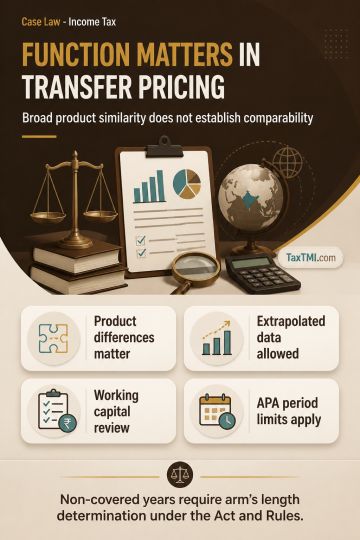
Transfer pricing comparability requires functional alignment and permits working capital adjustment, while APA margins cannot govern non-covered years...
Treaty benefit, goodwill depreciation and hedging costs: export commission disallowed, while key business deductions and depreciation claims succeeded...
Undisclosed foreign asset classification requires an unexplained source; unrebutted affidavits and corroborative evidence defeated the Black Money Act...
AAR held that renting of residential dwellings by unregistered landlords to the applicant, a registered entity, constitutes a taxable supply of services to the applicant under GST. The employer-employee relationship applies only between the applicant and its employees, not between the landlords and the applicant; therefore, the exemption for residential dwelling services is inapplicable. Consequently, GST is payable by the applicant under the Reverse Charge Mechanism on rent paid to unregistered landlords. Further, AAR held that, in view of s.17(2) read with s.2(47), the applicant is not eligible to claim ITC on GST paid under reverse charge, as the corresponding outward supply to employees is an exempt supply.
AAR held that renting of residential dwellings by unregistered landlords to the applicant, a registered entity, constitutes a taxable supply of services to the applicant under GST. The employer-employee relationship applies only between the applicant and its employees, not between the landlords and the applicant; therefore, the exemption for residential dwelling services is inapplicable. Consequently, GST is payable by the applicant under the Reverse Charge Mechanism on rent paid to unregistered landlords. Further, AAR held that, in view of s.17(2) read with s.2(47), the applicant is not eligible to claim ITC on GST paid under reverse charge, as the corresponding outward supply to employees is an exempt supply.
Note: It is a system-generated summary and is for quick reference only.
 TaxTMI
 of 4801
















 Join Channel


 TaxTMI