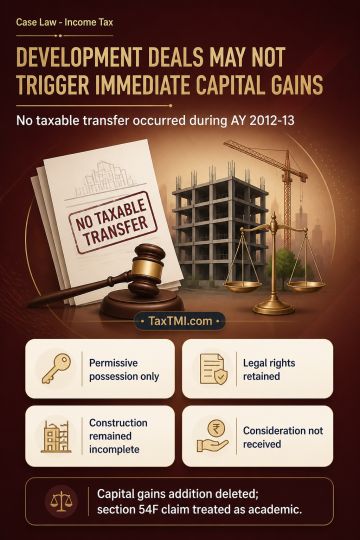
Development agreements require legal possession or effective enjoyment for capital gains transfer; permissive possession and deferred consideration de...
Prolonged sterilisation of development rights supports capital-gains treatment, while business-income disallowances cannot govern capital-gains comput...
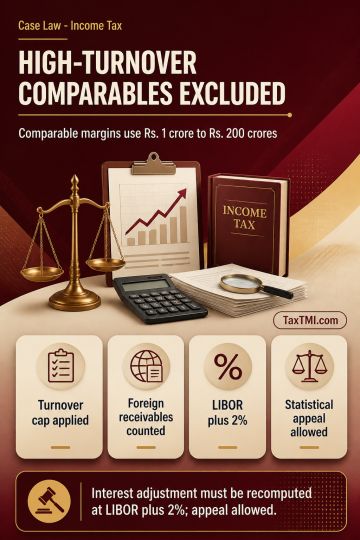
Additional evidence in transfer pricing dispute leads to fresh examination, while tax deductions, TDS credit, fee and refund interest require verifica...
Category II AIF pass-through taxation preserves non-business income character; investment receipts cannot be reclassified without applying recognised ...
Mutual fund maturity rules require proper rollover, redemption, disclosure, and due diligence; investor gains cannot excuse regulatory breaches or pen...
HC upheld the order of CIT(A) deleting the addition made by the AO on account of alleged unexplained income from sale of shares of Global Capital Markets Ltd. The HC held that the AO's addition was based solely on unsubstantiated third-party information regarding penny stock transactions, without disclosing the source or material to the assessee and without conducting any independent inquiry. The assessee had demonstrably purchased the shares in 2003 and sold them in 2010 through a recognized stock exchange after payment of STT, negating the allegation of short-term accommodation entries. As the transaction was supported by proper documentation and the Revenue failed to prove that the consideration was bogus or that the entities were fictitious, the HC found no perversity in the CIT(A)'s reasoning and dismissed the Revenue's appeal.
HC upheld the order of CIT(A) deleting the addition made by the AO on account of alleged unexplained income from sale of shares of Global Capital Markets Ltd. The HC held that the AO's addition was based solely on unsubstantiated third-party information regarding penny stock transactions, without disclosing the source or material to the assessee and without conducting any independent inquiry. The assessee had demonstrably purchased the shares in 2003 and sold them in 2010 through a recognized stock exchange after payment of STT, negating the allegation of short-term accommodation entries. As the transaction was supported by proper documentation and the Revenue failed to prove that the consideration was bogus or that the entities were fictitious, the HC found no perversity in the CIT(A)'s reasoning and dismissed the Revenue's appeal.
Note: It is a system-generated summary and is for quick reference only.
 TaxTMI
 of 4807














 Join Channel


 TaxTMI