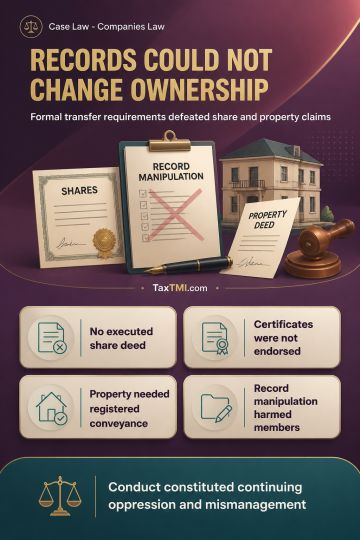
Statutory transfer formalities invalidated alleged share and property transfers, while retrospective record manipulation constituted oppression and mi...
Provisional attachment of laundered funds and equivalent-value property sustained, with statutory protection limited to pension, gratuity and providen...
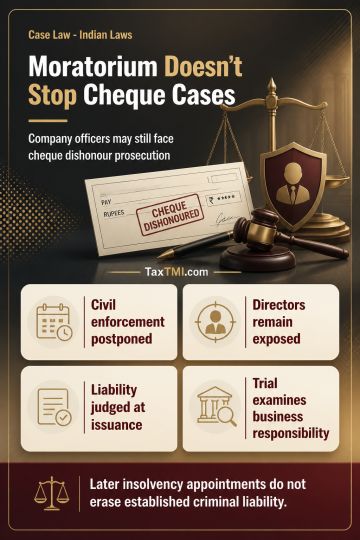
Insolvency moratorium does not shield company officers from cheque dishonour prosecution for liability arising before corporate insolvency proceedings...
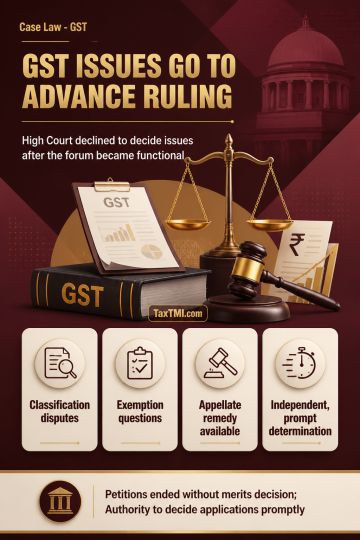
Advance-ruling mechanism governs pending GST classification, exemption and taxability disputes, limiting writ review once the specialised forum functi...
Page of 4805
Press 'Enter' after typing page number.
921 to 940 of 96092 Results
❮
❯
❯❯
0 / 200
Expand Note
Add to Folder
No Folders have been created
+
Are you sure you want to delete "My most important" ?
HC held that orders obtained through fraud in the company's liquidation proceedings are nullities and liable to be set aside notwithstanding the lapse of over 30 years, as fraud vitiates limitation and all judicial acts. The appointment and continued control of the Special Officer, who had undisclosed conflicting interests and surreptitiously became the largest creditor and shareholder, was found to be an abuse of process. HC concluded that, given the company's concealed assets, absence of claims from creditors or employees, and the principle that winding up is a last resort, the company should not continue in liquidation and its remaining/traced assets must enure to its benefit. All applications seeking to sustain the fraudulent arrangement, including the prayer to transfer the matter to NCLT, were rejected, and the proceedings were disposed of accordingly.
HC held that orders obtained through fraud in the company's liquidation proceedings are nullities and liable to be set aside notwithstanding the lapse of over 30 years, as fraud vitiates limitation and all judicial acts. The appointment and continued control of the Special Officer, who had undisclosed conflicting interests and surreptitiously became the largest creditor and shareholder, was found to be an abuse of process. HC concluded that, given the company's concealed assets, absence of claims from creditors or employees, and the principle that winding up is a last resort, the company should not continue in liquidation and its remaining/traced assets must enure to its benefit. All applications seeking to sustain the fraudulent arrangement, including the prayer to transfer the matter to NCLT, were rejected, and the proceedings were disposed of accordingly.
Note: It is a system-generated summary and is for quick reference only.
 TaxTMI
 of 4805









 Join Channel


 TaxTMI