Business expenditure deduction requires proof of genuine commission payments and commercial allowability; turnover growth alone cannot validate the cl...
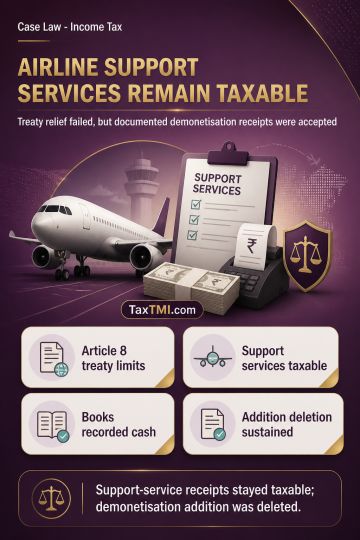
Article 8 treaty coverage excluded third-party airline support services, while documented demonetisation cash receipts remained accepted business inco...
Functional comparability under TNMM requires highway contract benchmarks to reflect operation, maintenance and transfer activities, requiring fresh be...
Objective characteristics govern magnesium bis-glycinate chelate classification as an amino-acid coordination compound, not a food preparation or anti...
Page of 4803
Press 'Enter' after typing page number.
581 to 600 of 96046 Results
❮
❯
❯❯
0 / 200
Expand Note
Add to Folder
No Folders have been created
+
Are you sure you want to delete "My most important" ?
HC held that orders obtained through fraud in the company's liquidation proceedings are nullities and liable to be set aside notwithstanding the lapse of over 30 years, as fraud vitiates limitation and all judicial acts. The appointment and continued control of the Special Officer, who had undisclosed conflicting interests and surreptitiously became the largest creditor and shareholder, was found to be an abuse of process. HC concluded that, given the company's concealed assets, absence of claims from creditors or employees, and the principle that winding up is a last resort, the company should not continue in liquidation and its remaining/traced assets must enure to its benefit. All applications seeking to sustain the fraudulent arrangement, including the prayer to transfer the matter to NCLT, were rejected, and the proceedings were disposed of accordingly.
HC held that orders obtained through fraud in the company's liquidation proceedings are nullities and liable to be set aside notwithstanding the lapse of over 30 years, as fraud vitiates limitation and all judicial acts. The appointment and continued control of the Special Officer, who had undisclosed conflicting interests and surreptitiously became the largest creditor and shareholder, was found to be an abuse of process. HC concluded that, given the company's concealed assets, absence of claims from creditors or employees, and the principle that winding up is a last resort, the company should not continue in liquidation and its remaining/traced assets must enure to its benefit. All applications seeking to sustain the fraudulent arrangement, including the prayer to transfer the matter to NCLT, were rejected, and the proceedings were disposed of accordingly.
Note: It is a system-generated summary and is for quick reference only.
 TaxTMI
 of 4803













 Join Channel


 TaxTMI