Business expenditure deduction requires proof of genuine commission payments and commercial allowability; turnover growth alone cannot validate the cl...
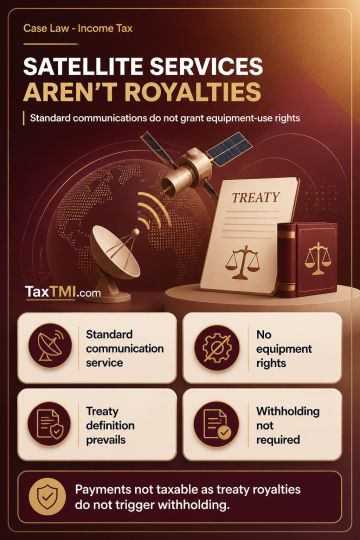
Article 8 treaty coverage excluded third-party airline support services, while documented demonetisation cash receipts remained accepted business inco...
Functional comparability under TNMM requires highway contract benchmarks to reflect operation, maintenance and transfer activities, requiring fresh be...
Objective characteristics govern magnesium bis-glycinate chelate classification as an amino-acid coordination compound, not a food preparation or anti...
Page of 4803
Press 'Enter' after typing page number.
581 to 600 of 96046 Results
❮
❯
❯❯
0 / 200
Expand Note
Add to Folder
No Folders have been created
+
Are you sure you want to delete "My most important" ?
AT set aside SEBI's order holding the appellant guilty of insider trading in the shares of GGL. It held that the alleged "high probability of detection of fraud" on retirement of a PNB officer did not constitute UPSI under the PIT Regulations, as mere probability of future detection is neither concrete nor credible information. AT further held that the appellant's limited business dealings and minority shareholding did not render him a "connected person" or "insider", there being no reasonable expectation of access to UPSI and no evidence of communication of UPSI from Noticee No.1. Trading was found consistent with market behaviour and price movements, not guided by UPSI. Consequently, allegations of violation of Sections 12A(d), 12A(e) of the SEBI Act and Regulation 4(1) of the PIT Regulations failed and the appeal was allowed.
AT set aside SEBI's order holding the appellant guilty of insider trading in the shares of GGL. It held that the alleged "high probability of detection of fraud" on retirement of a PNB officer did not constitute UPSI under the PIT Regulations, as mere probability of future detection is neither concrete nor credible information. AT further held that the appellant's limited business dealings and minority shareholding did not render him a "connected person" or "insider", there being no reasonable expectation of access to UPSI and no evidence of communication of UPSI from Noticee No.1. Trading was found consistent with market behaviour and price movements, not guided by UPSI. Consequently, allegations of violation of Sections 12A(d), 12A(e) of the SEBI Act and Regulation 4(1) of the PIT Regulations failed and the appeal was allowed.
Note: It is a system-generated summary and is for quick reference only.
 TaxTMI
 of 4803


















 Join Channel


 TaxTMI