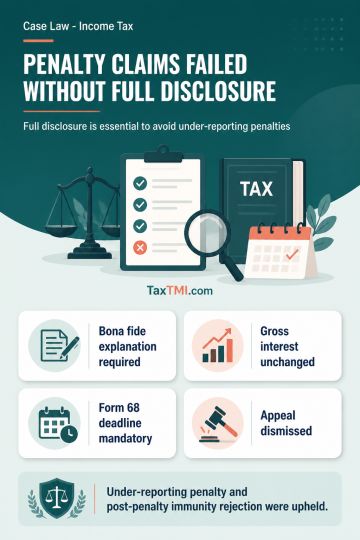
Bona fide disclosure requirements govern under-reporting penalties, and post-penalty immunity applications cannot secure available statutory protectio...
Certificate-of-origin verification procedure governs preferential customs benefits; denial without retroactive verification was set aside with consequ...
Disciplinary Committee jurisdiction and mandatory investigation requirements invalidated cancellation of an insolvency professional's registration and...
Retention of seized property survives where recorded reasons support proceeds of crime, while stayed investigation periods are excluded from limitatio...
Specified income of Baddi Barotiwala Nalagarh Development Authority receives conditional tax exemption, retrospectively covering its designated assess...
Page of 4805
Press 'Enter' after typing page number.
1221 to 1240 of 96092 Results
❮
❯
❯❯
0 / 200
Expand Note
Add to Folder
No Folders have been created
+
Are you sure you want to delete "My most important" ?
CESTAT held that the order of absolute confiscation of the impugned goods, earlier directed by the Commr. (Appeals), was unsustainable as the goods had already been re-exported. The appellant produced the Let Export Order dated 07.10.2019 showing re-export, which predated both the Review Order of the Commr. of Customs and the subsequent Revenue appeal. The Tribunal noted that the department had been duly informed of the re-export, yet the Commr. proceeded without considering this material fact. Applying the settled legal principle that confiscation cannot be ordered when goods are no longer available and have not been cleared under bond, CESTAT set aside the absolute confiscation and any consequential directions. The appeal of the assessee was accordingly allowed, and the Revenue's action was held to be unwarranted in law.
CESTAT held that the order of absolute confiscation of the impugned goods, earlier directed by the Commr. (Appeals), was unsustainable as the goods had already been re-exported. The appellant produced the Let Export Order dated 07.10.2019 showing re-export, which predated both the Review Order of the Commr. of Customs and the subsequent Revenue appeal. The Tribunal noted that the department had been duly informed of the re-export, yet the Commr. proceeded without considering this material fact. Applying the settled legal principle that confiscation cannot be ordered when goods are no longer available and have not been cleared under bond, CESTAT set aside the absolute confiscation and any consequential directions. The appeal of the assessee was accordingly allowed, and the Revenue's action was held to be unwarranted in law.
Note: It is a system-generated summary and is for quick reference only.
 TaxTMI
 of 4805




















 Join Channel


 TaxTMI