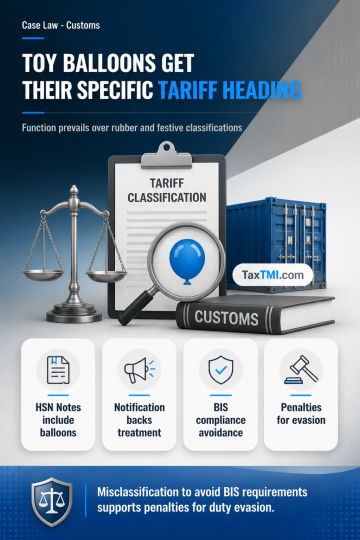
Toy balloon tariff classification: functional heading prevails over residual rubber and festive article headings, supporting penalties for deliberate ...
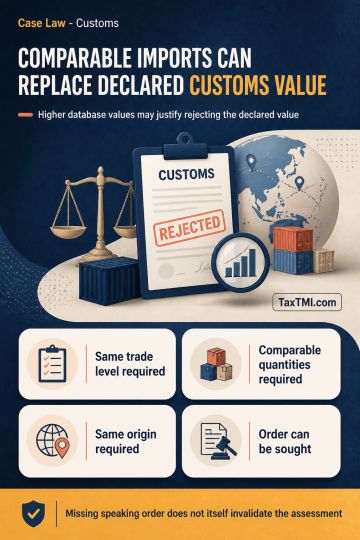
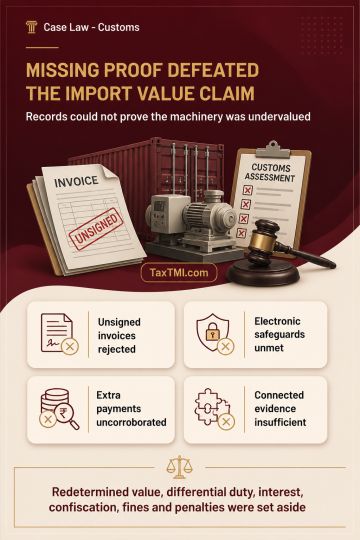
Customs valuation using comparable contemporaneous imports can displace declared value, while missing speaking orders require pursuit before competent...
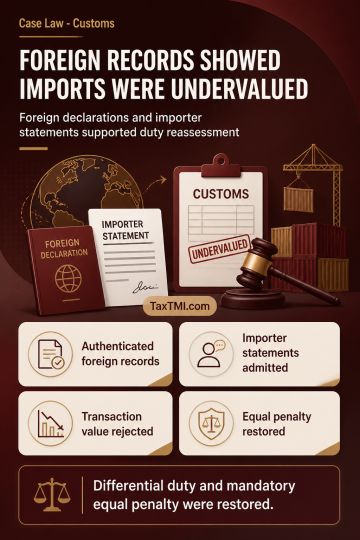
Foreign customs declarations and importer admissions established undervaluation, supporting sequential value redetermination, differential duty, and m...
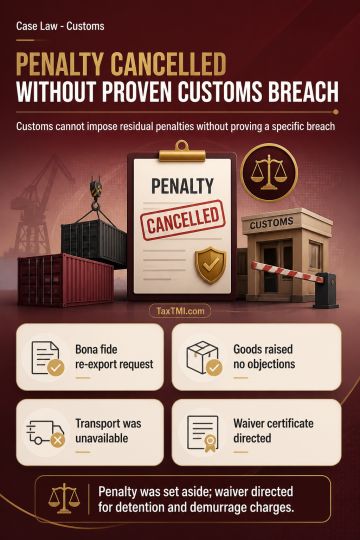
Customs seizure safeguards prevent detention-based limitation avoidance and invalidate provisional release conditions for imported vehicles under an i...
Page of 4828
Press 'Enter' after typing page number.
361 to 380 of 96556 Results
❮
❯
❯❯
0 / 200
Expand Note
Add to Folder
No Folders have been created
+
Are you sure you want to delete "My most important" ?
AT held that the company and its KMPs engaged in self-funding of preferential allotment in breach of s.77(2) Companies Act and Regulations 3,4(1) of the PFUTP Regulations, and that several allottee and conduit entities aided the scheme; the Tribunal found a proximate fund flow of Rs.3.42 crore originating from the company into preferential subscriptions and sustained liability for that quantum. However, AT accepted that conduit entities had received Rs.10.47 crore and that no sufficient linkage was established for the excess transfers; considering those facts and attendant evidence, AT allowed the appeal challenging the impugned penalties as applied jointly and severally to the appellants, while rejecting delay-based dismissal.
AT held that the company and its KMPs engaged in self-funding of preferential allotment in breach of s.77(2) Companies Act and Regulations 3,4(1) of the PFUTP Regulations, and that several allottee and conduit entities aided the scheme; the Tribunal found a proximate fund flow of Rs.3.42 crore originating from the company into preferential subscriptions and sustained liability for that quantum. However, AT accepted that conduit entities had received Rs.10.47 crore and that no sufficient linkage was established for the excess transfers; considering those facts and attendant evidence, AT allowed the appeal challenging the impugned penalties as applied jointly and severally to the appellants, while rejecting delay-based dismissal.
Note: It is a system-generated summary and is for quick reference only.
 TaxTMI
  TaxTMI
 of 4828











 Join Channel