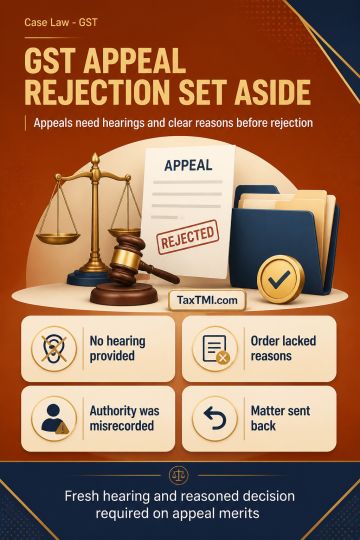
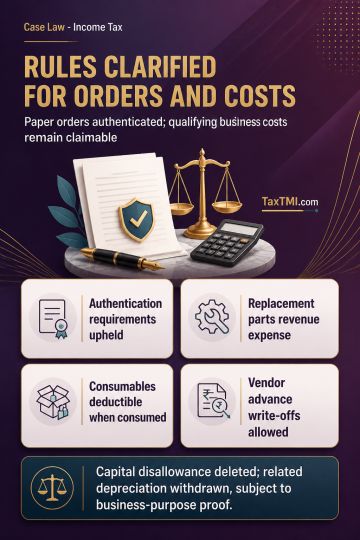
Authentication of paper assessment orders upheld, while qualifying repairs, consumables and vendor advance write-offs remain deductible business claim...
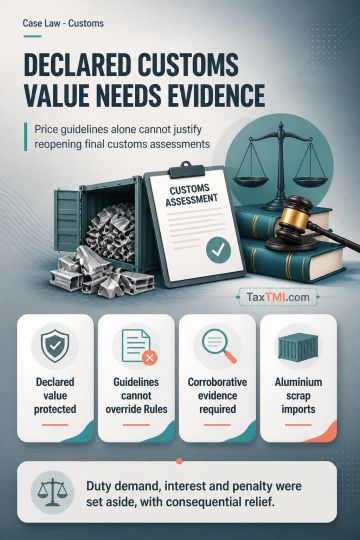
Transaction value cannot be rejected solely on non-statutory valuation guidelines without corroborative evidence supporting reassessment of final cust...
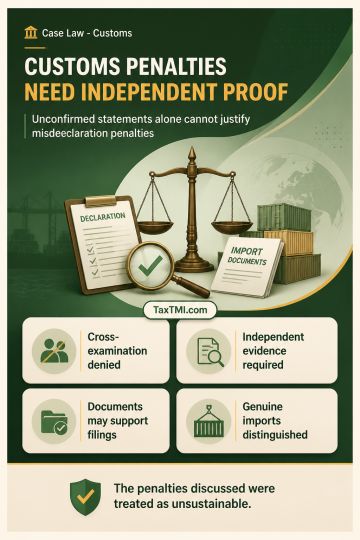
Cross-examination rights and corroborated evidence limit customs penalties for misdeclaration in genuine import transactions involving documented clea...
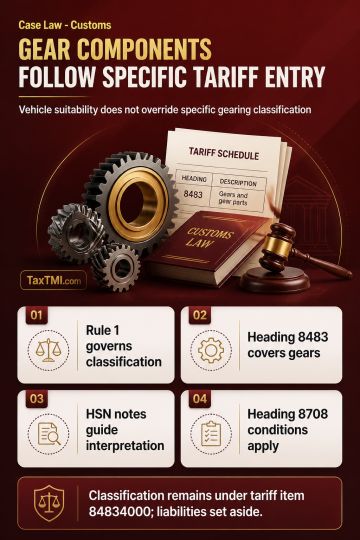
Tariff classification of vehicle gear components follows the specific gearing entry, displacing motor-vehicle parts classification and related liabili...
Page of 4798
Press 'Enter' after typing page number.
621 to 640 of 95955 Results
❮
❯
❯❯
0 / 200
Expand Note
Add to Folder
No Folders have been created
+
Are you sure you want to delete "My most important" ?
AAR held that fusible interlining fabric composed of 85% or more cotton is classifiable under Chapter 52 of the Tariff Schedule. Relying on the legal effect of the Tribunal's prior order and Circular No. 5/89 concerning the treatment of fusible interlinings before the insertion and after deletion of Note 2(c) to Chapter 59, the Authority concluded that such goods are to be classified according to their predominant textile material; where cotton predominates, Chapter 52 applies. The applicant's submitted laboratory test establishing textile composition governed the classification outcome, resulting in duty treatment and tariff classification under Chapter 52.
AAR held that fusible interlining fabric composed of 85% or more cotton is classifiable under Chapter 52 of the Tariff Schedule. Relying on the legal effect of the Tribunal's prior order and Circular No. 5/89 concerning the treatment of fusible interlinings before the insertion and after deletion of Note 2(c) to Chapter 59, the Authority concluded that such goods are to be classified according to their predominant textile material; where cotton predominates, Chapter 52 applies. The applicant's submitted laboratory test establishing textile composition governed the classification outcome, resulting in duty treatment and tariff classification under Chapter 52.
Note: It is a system-generated summary and is for quick reference only.
 TaxTMI
 of 4798









 Join Channel


 TaxTMI