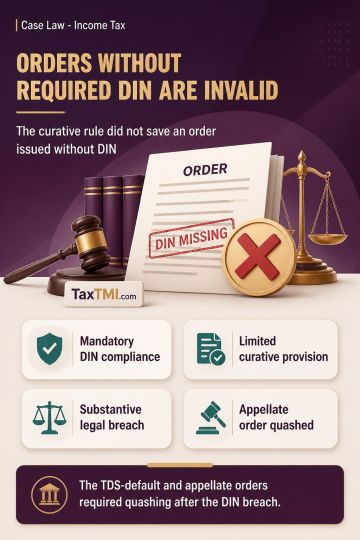
Document Identification Number compliance renders TDS-default orders invalid where mandatory DIN requirements are breached and curative provision does...
ITAT allowed the appeal and set aside the Principal Commissioner's revisional order under s.263. The Tribunal held that s.263 is confined to correcting patent errors causing prejudice to the Revenue and does not permit reappreciation of evidence or substitution of the AO's view; Explanation 2 applies only where enquiry or verification is absent. The Principal Commissioner's premise that the taxpayer recovered ESOP costs was a factual misconception: ledger, financials and TDS reconciliation demonstrated only statutory TDS pass-through, not reimbursement, negating any prejudice to the Revenue. On merits the ESOP discount was held deductible under s.37(1) as employee remuneration incurred wholly and exclusively for business, making the AO's acceptance a tenable view.
ITAT allowed the appeal and set aside the Principal Commissioner's revisional order under s.263. The Tribunal held that s.263 is confined to correcting patent errors causing prejudice to the Revenue and does not permit reappreciation of evidence or substitution of the AO's view; Explanation 2 applies only where enquiry or verification is absent. The Principal Commissioner's premise that the taxpayer recovered ESOP costs was a factual misconception: ledger, financials and TDS reconciliation demonstrated only statutory TDS pass-through, not reimbursement, negating any prejudice to the Revenue. On merits the ESOP discount was held deductible under s.37(1) as employee remuneration incurred wholly and exclusively for business, making the AO's acceptance a tenable view.
Note: It is a system-generated summary and is for quick reference only.
 TaxTMI
  TaxTMI
 of 4918