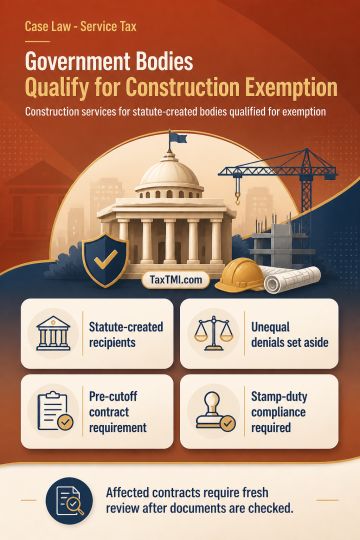
Governmental authority status supports construction-service exemption, while pre-cutoff contract and stamp-duty compliance requires verification on re...
Automated Free Sale and Commerce Certificates enable paperless processing while retaining risk-based manual verification for selected exporter applica...
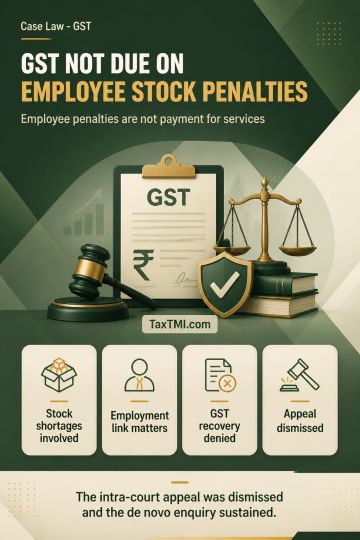
Employee stock-shortage penalties do not constitute consideration for services, preventing GST collection under Schedule II in employment relationship...
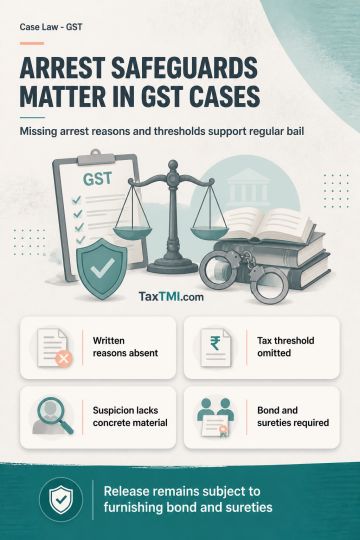
The SC held that the arresting authorities violated Article 22(1) and Section 50 CrPC (now s.47 BNSS) by failing to furnish written grounds of arrest to the appellants, rendering the arrest and consequent remand illegal and entitling the appellants to be set at liberty. The Court affirmed that informing grounds of arrest is a mandatory constitutional safeguard to enable defence and legal consultation; while oral communication is permissible in exigent circumstances (e.g., flagrante delicto), a written statement in a language understood by the arrestee must be provided within a reasonable time and, in any event, not later than two hours before production for remand. Appeal disposed.
The SC held that the arresting authorities violated Article 22(1) and Section 50 CrPC (now s.47 BNSS) by failing to furnish written grounds of arrest to the appellants, rendering the arrest and consequent remand illegal and entitling the appellants to be set at liberty. The Court affirmed that informing grounds of arrest is a mandatory constitutional safeguard to enable defence and legal consultation; while oral communication is permissible in exigent circumstances (e.g., flagrante delicto), a written statement in a language understood by the arrestee must be provided within a reasonable time and, in any event, not later than two hours before production for remand. Appeal disposed.
Note: It is a system-generated summary and is for quick reference only.
 TaxTMI
  TaxTMI
 of 4828










 Join Channel


