Mutual fund maturity rules require proper rollover, redemption, disclosure, and due diligence; investor gains cannot excuse regulatory breaches or pen...
Threshold exemption excludes exempt services, while stamp-paper purchases avoid reverse charge; consequential service tax penalties were also set asid...
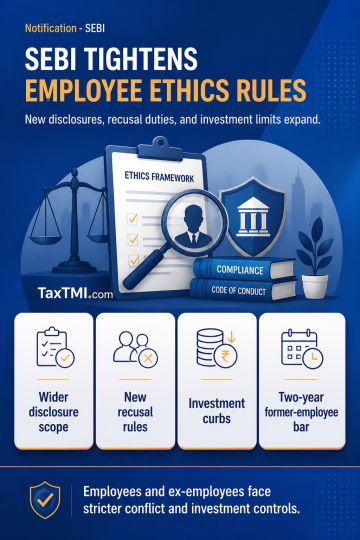
Employee conflict disclosures and investment restrictions expand with new recusal duties, post-employment limits, and compliance reporting requirement...
The HC quashed proceedings initiated under s.130 read with s.122 of the GST Act against the petitioner, holding that survey-discovered excess stock must be addressed under the statutory machinery of s.73/74 and not by invoking s.130. The court emphasized that the GST Act is a self-contained code prescribing specific procedures where goods are unrecorded in books, obliging the proper officer to proceed under s.73/74. Reliance on prior higher-court rulings confirming that s.130 is inapplicable to excess stock found during survey reinforced the conclusion. Consequently, the impugned orders based on s.130/ s.122 were held unsustainable and were quashed; the petition was allowed.
The HC quashed proceedings initiated under s.130 read with s.122 of the GST Act against the petitioner, holding that survey-discovered excess stock must be addressed under the statutory machinery of s.73/74 and not by invoking s.130. The court emphasized that the GST Act is a self-contained code prescribing specific procedures where goods are unrecorded in books, obliging the proper officer to proceed under s.73/74. Reliance on prior higher-court rulings confirming that s.130 is inapplicable to excess stock found during survey reinforced the conclusion. Consequently, the impugned orders based on s.130/ s.122 were held unsustainable and were quashed; the petition was allowed.
Note: It is a system-generated summary and is for quick reference only.
 TaxTMI
 of 4801















 Join Channel


 TaxTMI
