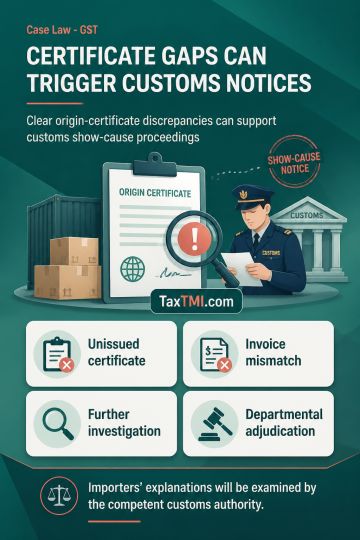
Jurisdictional facts in certificate-of-origin discrepancies can support customs show-cause proceedings, leaving factual explanations for departmental ...
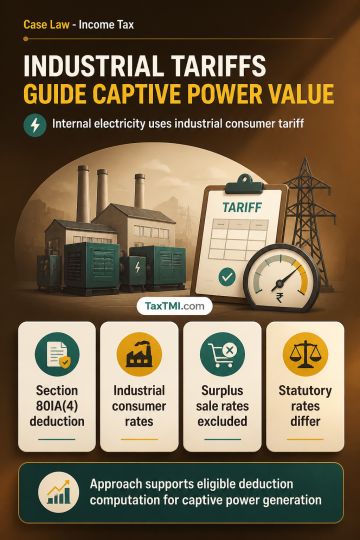
Market value for captive electricity consumption follows industrial consumer tariffs, supporting profit computation for the power generation deduction...
The HC quashed proceedings initiated under s.130 read with s.122 of the GST Act against the petitioner, holding that survey-discovered excess stock must be addressed under the statutory machinery of s.73/74 and not by invoking s.130. The court emphasized that the GST Act is a self-contained code prescribing specific procedures where goods are unrecorded in books, obliging the proper officer to proceed under s.73/74. Reliance on prior higher-court rulings confirming that s.130 is inapplicable to excess stock found during survey reinforced the conclusion. Consequently, the impugned orders based on s.130/ s.122 were held unsustainable and were quashed; the petition was allowed.
The HC quashed proceedings initiated under s.130 read with s.122 of the GST Act against the petitioner, holding that survey-discovered excess stock must be addressed under the statutory machinery of s.73/74 and not by invoking s.130. The court emphasized that the GST Act is a self-contained code prescribing specific procedures where goods are unrecorded in books, obliging the proper officer to proceed under s.73/74. Reliance on prior higher-court rulings confirming that s.130 is inapplicable to excess stock found during survey reinforced the conclusion. Consequently, the impugned orders based on s.130/ s.122 were held unsustainable and were quashed; the petition was allowed.
Note: It is a system-generated summary and is for quick reference only.
 TaxTMI
 of 4800







 Join Channel


 TaxTMI