Business expenditure deduction requires proof of genuine commission payments and commercial allowability; turnover growth alone cannot validate the cl...
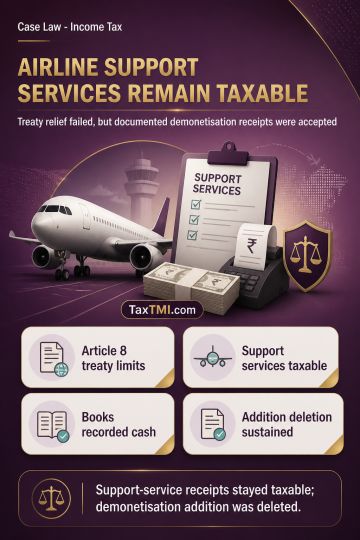
Article 8 treaty coverage excluded third-party airline support services, while documented demonetisation cash receipts remained accepted business inco...
Functional comparability under TNMM requires highway contract benchmarks to reflect operation, maintenance and transfer activities, requiring fresh be...
The ITAT set aside the CPC, Bengaluru intimation under s.143(1) of the Act, holding that the centralized adjustment restricting the assessee's claim of exemption under s.10(10AA) was invalid for failure to comply with the mandatory first proviso to s.143(1)(a). The Tribunal held that prior written or electronic intimation specifying the proposed adjustment and affording the assessee a 30-day opportunity to respond is a statutory precondition and an essential element of audi alteram partem. Absent such prior intimation, the adjustment was held to be ultravires and violative of natural justice. The impugned intimation was quashed and the appeal of the assessee was allowed.
The ITAT set aside the CPC, Bengaluru intimation under s.143(1) of the Act, holding that the centralized adjustment restricting the assessee's claim of exemption under s.10(10AA) was invalid for failure to comply with the mandatory first proviso to s.143(1)(a). The Tribunal held that prior written or electronic intimation specifying the proposed adjustment and affording the assessee a 30-day opportunity to respond is a statutory precondition and an essential element of audi alteram partem. Absent such prior intimation, the adjustment was held to be ultravires and violative of natural justice. The impugned intimation was quashed and the appeal of the assessee was allowed.
Note: It is a system-generated summary and is for quick reference only.
 TaxTMI
 of 4792














 Join Channel


 TaxTMI
