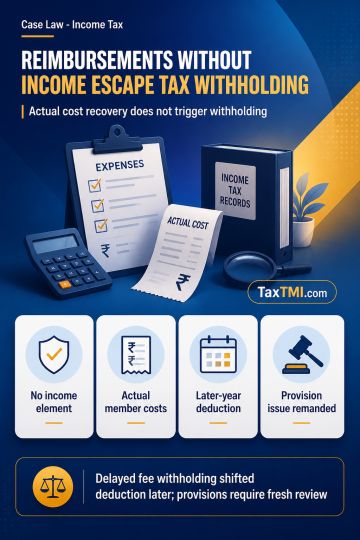
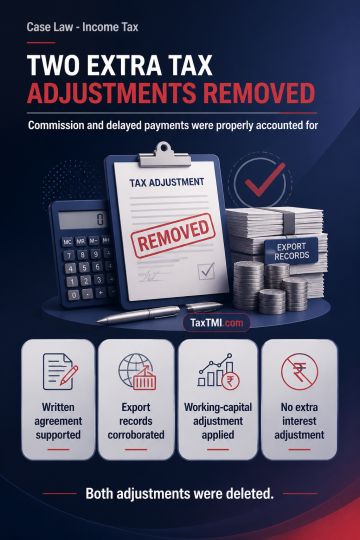
Pure reimbursement without income element escapes tax withholding, while delayed withholding and unsupported provisions face deferred or renewed scrut...
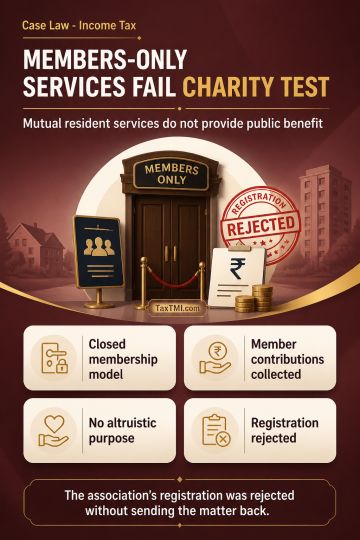
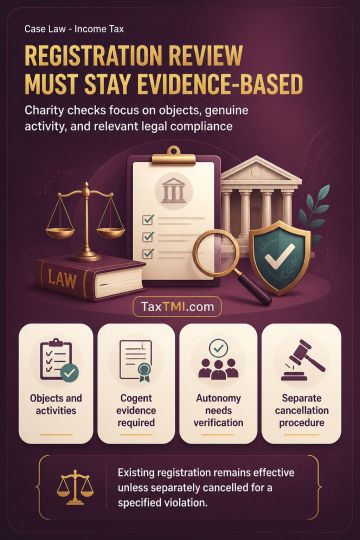
Public benefit requirement defeats charitable registration where residents' association services are reciprocal, member-only facilities governed by mu...
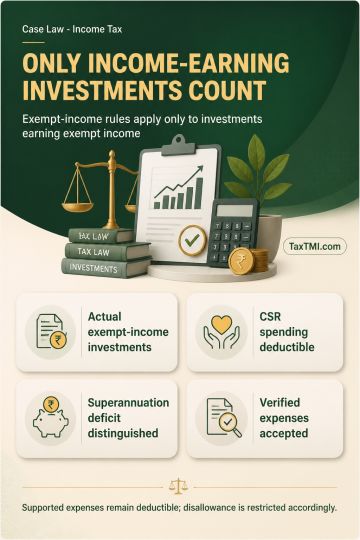
Exempt-income expenditure disallowance is confined to investments that actually generated exempt income, while supported business expenses remain dedu...
Objective characteristics and principal use govern mining-tyre classification, while fresh advance ruling applications may rely on additional technica...
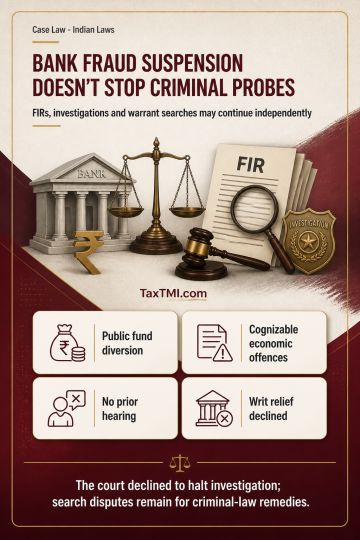
Administrative fraud classification suspension does not halt independent criminal investigation or warrant-based searches into alleged economic offenc...
Page of 4803
Press 'Enter' after typing page number.
761 to 780 of 96046 Results
❮
❯
❯❯
0 / 200
Expand Note
Add to Folder
No Folders have been created
+
Are you sure you want to delete "My most important" ?
ITAT allowed the appeal in part and remitted the matter to CIT(E) for limited inquiry. The Tribunal held that a trust/fund may be of composite charitable and religious character and is disqualified under s.80G(5) only if application of income to religious purposes exceeds the 5% threshold in s.80G(5B). Noting CIT(E) had found religious expenditure over 5% but had not considered the applicant's explanations that those outlays were charitable, the ITAT directed cit(E) to examine and verify the applicant's submissions against s.80G(5B) and, if the religious expenditure does not exceed the statutory limit, to grant approval under s.80G. Appeal allowed for statistical purposes.
ITAT allowed the appeal in part and remitted the matter to CIT(E) for limited inquiry. The Tribunal held that a trust/fund may be of composite charitable and religious character and is disqualified under s.80G(5) only if application of income to religious purposes exceeds the 5% threshold in s.80G(5B). Noting CIT(E) had found religious expenditure over 5% but had not considered the applicant's explanations that those outlays were charitable, the ITAT directed cit(E) to examine and verify the applicant's submissions against s.80G(5B) and, if the religious expenditure does not exceed the statutory limit, to grant approval under s.80G. Appeal allowed for statistical purposes.
Note: It is a system-generated summary and is for quick reference only.
 TaxTMI
 of 4803





 Join Channel


 TaxTMI