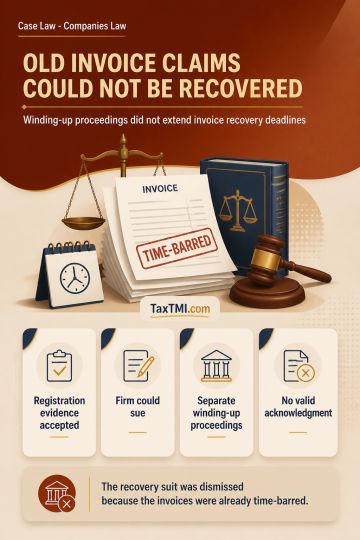
Invoice-based recovery claims remain time-barred despite separate winding-up proceedings, absent valid acknowledgment or part-payment of the disputed ...
Extended limitation fails without specific suppression allegations, while overseas employee secondment remains taxable as manpower supply within norma...
Time-share accommodation classification excludes Club or Association Service where purchasers receive contractual occupancy rights without genuine mem...
CENVAT credit for trading requires reversal, while taxable-service rental credit remains proportionately available and limitation issues await resolut...
Page of 4792
Press 'Enter' after typing page number.
61 to 80 of 95833 Results
❮
❯
❯❯
0 / 200
Expand Note
Add to Folder
No Folders have been created
+
Are you sure you want to delete "My most important" ?
ITAT held that where the payee has declared the receipts and discharged tax liability, the payer cannot be treated as an assessee in default under s.201/201(1A); the AO must first ascertain default before invoking disallowance. Applying this principle, the Tribunal found the taxpayer's contract involved a 4% supervision margin payable to the contractor for construction of an institutional facility and, given the charitable context and non-commencement of the project, afforded the assessee the benefit of doubt. The AO was directed to treat only the 4% margin as fees chargeable under s.194J. Other administrative and allied payments were sustained. Grounds were accordingly partly allowed.
ITAT held that where the payee has declared the receipts and discharged tax liability, the payer cannot be treated as an assessee in default under s.201/201(1A); the AO must first ascertain default before invoking disallowance. Applying this principle, the Tribunal found the taxpayer's contract involved a 4% supervision margin payable to the contractor for construction of an institutional facility and, given the charitable context and non-commencement of the project, afforded the assessee the benefit of doubt. The AO was directed to treat only the 4% margin as fees chargeable under s.194J. Other administrative and allied payments were sustained. Grounds were accordingly partly allowed.
Note: It is a system-generated summary and is for quick reference only.
 TaxTMI
 of 4792















 Join Channel


 TaxTMI

