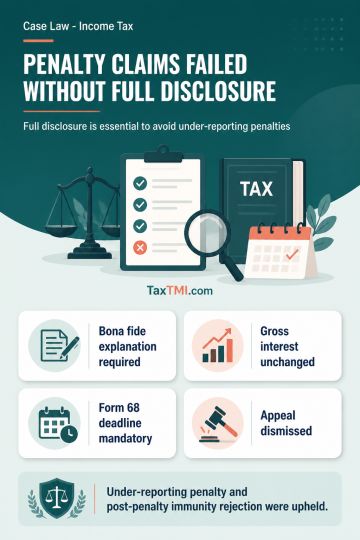
Bona fide disclosure requirements govern under-reporting penalties, and post-penalty immunity applications cannot secure available statutory protectio...
Certificate-of-origin verification procedure governs preferential customs benefits; denial without retroactive verification was set aside with consequ...
Disciplinary Committee jurisdiction and mandatory investigation requirements invalidated cancellation of an insolvency professional's registration and...
ITAT affirmed that the assessee is entitled to deductions under both s.36(1)(vii) and s.36(1)(viia)(c), holding the proviso to s.36(1)(vii) merely caps bad-debt write-offs by the credit balance in provisions to prevent double deduction; factual review showed no excess or duplication, so CIT(A)'s allowance was upheld. On s.14A, the Tribunal directed the AO to confine disallowance to the assessee's suo-motu pro-rata allocation to investment-department costs, rejecting the AO's challenge absent specific contrary accounting findings. Deductions under s.36(1)(viii) were held independent of s.36(1)(viia)(c) computations. The amortised rent issue was remitted to the AO for reconsideration under s.158A upon Form-8 compliance.
ITAT affirmed that the assessee is entitled to deductions under both s.36(1)(vii) and s.36(1)(viia)(c), holding the proviso to s.36(1)(vii) merely caps bad-debt write-offs by the credit balance in provisions to prevent double deduction; factual review showed no excess or duplication, so CIT(A)'s allowance was upheld. On s.14A, the Tribunal directed the AO to confine disallowance to the assessee's suo-motu pro-rata allocation to investment-department costs, rejecting the AO's challenge absent specific contrary accounting findings. Deductions under s.36(1)(viii) were held independent of s.36(1)(viia)(c) computations. The amortised rent issue was remitted to the AO for reconsideration under s.158A upon Form-8 compliance.
Note: It is a system-generated summary and is for quick reference only.
 TaxTMI
 of 4805














 Join Channel


 TaxTMI
