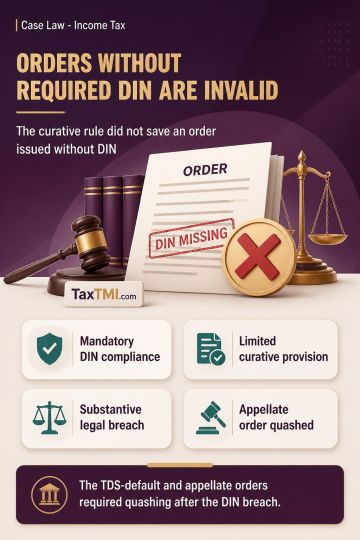
Document Identification Number compliance renders TDS-default orders invalid where mandatory DIN requirements are breached and curative provision does...
CESTAT allowed the appeal, set aside the confiscation and penalty. The tribunal held that Customs officers failed to form an independent reasonable belief of smuggling under s.110(1) CA 1962, having merely adopted CISF's initial detention; thus the seizure was arbitrary. The appellant subsequently produced verifiable documents proving domestic procurement and conversion of old jewellery into seven gold bars and silver, discharging the evidential burden under s.123 CA 1962. No cogent material established foreign origin or illicit importation of the bars; foreign markings alone were insufficient. Consequently the order of absolute confiscation under ss.112(a) and 112(b) and the attendant penalty were unsustainable and were set aside.
CESTAT allowed the appeal, set aside the confiscation and penalty. The tribunal held that Customs officers failed to form an independent reasonable belief of smuggling under s.110(1) CA 1962, having merely adopted CISF's initial detention; thus the seizure was arbitrary. The appellant subsequently produced verifiable documents proving domestic procurement and conversion of old jewellery into seven gold bars and silver, discharging the evidential burden under s.123 CA 1962. No cogent material established foreign origin or illicit importation of the bars; foreign markings alone were insufficient. Consequently the order of absolute confiscation under ss.112(a) and 112(b) and the attendant penalty were unsustainable and were set aside.
Note: It is a system-generated summary and is for quick reference only.
 TaxTMI
  TaxTMI
 of 4918