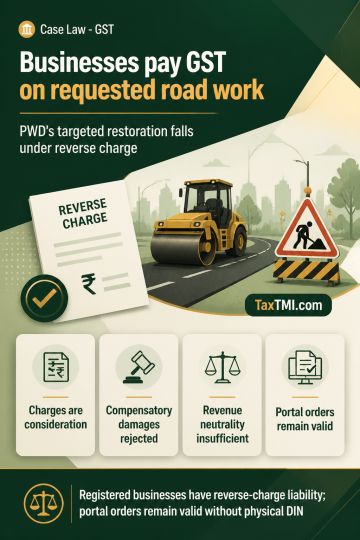
Request-driven road restoration attracts reverse-charge GST, not governmental-function treatment or compensatory-damages status for business recipient...
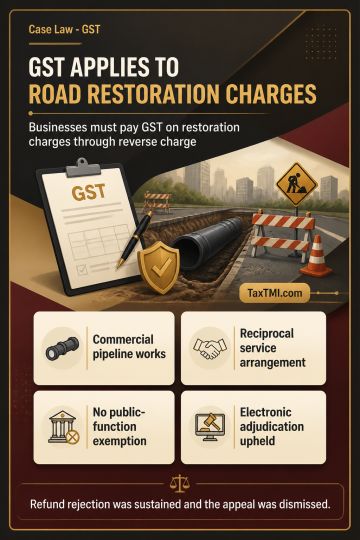
Road restoration charges for commercial pipeline works are taxable Government services, with reverse charge liability and no public-function exemption...
Model-wise import cap monitoring cannot justify withholding used multifunction machines where all-India tracking is absent and full security is furnis...
CESTAT allowed the appeal and set aside the penalty under s.112, Customs Act, 1962. The Tribunal found the appellant acted solely as a broker for commission and that the impugned order rested only on uncorroborated inculpatory statements which the appellant retracted. Statements recorded under s.108 were inadmissible in adjudication as the procedural safeguards in s.138B (examination/cross-examination) were not satisfied. The adjudicator failed to demonstrate how the alleged commercial link implicated the appellant in over-invoicing or circular trading. Further, s.112 was inapplicable: no prohibition was in force, no duty was payable, alleged value was not higher than declared, and no duty evasion was established.
CESTAT allowed the appeal and set aside the penalty under s.112, Customs Act, 1962. The Tribunal found the appellant acted solely as a broker for commission and that the impugned order rested only on uncorroborated inculpatory statements which the appellant retracted. Statements recorded under s.108 were inadmissible in adjudication as the procedural safeguards in s.138B (examination/cross-examination) were not satisfied. The adjudicator failed to demonstrate how the alleged commercial link implicated the appellant in over-invoicing or circular trading. Further, s.112 was inapplicable: no prohibition was in force, no duty was payable, alleged value was not higher than declared, and no duty evasion was established.
Note: It is a system-generated summary and is for quick reference only.
 TaxTMI
  TaxTMI
 of 4918