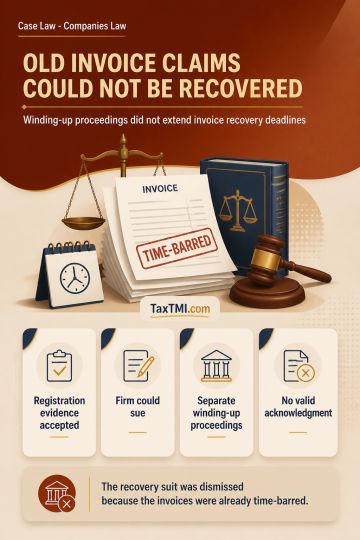
Invoice-based recovery claims remain time-barred despite separate winding-up proceedings, absent valid acknowledgment or part-payment of the disputed ...
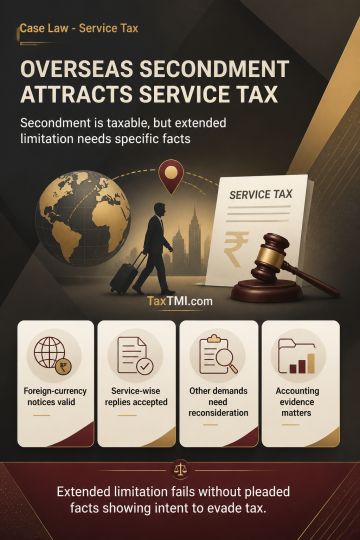
Extended limitation fails without specific suppression allegations, while overseas employee secondment remains taxable as manpower supply within norma...
Time-share accommodation classification excludes Club or Association Service where purchasers receive contractual occupancy rights without genuine mem...
Page of 4790
Press 'Enter' after typing page number.
21 to 40 of 95794 Results
❮
❯
❯❯
0 / 200
Expand Note
Add to Folder
No Folders have been created
+
Are you sure you want to delete "My most important" ?
The AAAR dismissed the appeal and held that import IGST paid via TR-6 challan is not an admissible document for claiming ITC because a TR-6 is a Treasury payment instrument and not a "bill of entry or any similar document" prescribed under the Customs Act or rules; consequently TR-6 (alone or read with SVB orders/letters) cannot support ITC. A re-assessed bill of entry, however, constitutes a prescribed document under r.36(1)(d) and thus may permit ITC, but such availment is governed by the time-bar in s.16(4) CGST, applied to IGST claims by s.20 IGST Act mutatis mutandis. Appeal dismissed.
The AAAR dismissed the appeal and held that import IGST paid via TR-6 challan is not an admissible document for claiming ITC because a TR-6 is a Treasury payment instrument and not a "bill of entry or any similar document" prescribed under the Customs Act or rules; consequently TR-6 (alone or read with SVB orders/letters) cannot support ITC. A re-assessed bill of entry, however, constitutes a prescribed document under r.36(1)(d) and thus may permit ITC, but such availment is governed by the time-bar in s.16(4) CGST, applied to IGST claims by s.20 IGST Act mutatis mutandis. Appeal dismissed.
Note: It is a system-generated summary and is for quick reference only.
 TaxTMI
 of 4790










 Join Channel


 TaxTMI

