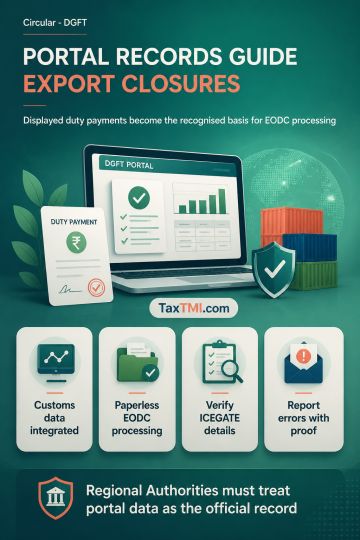
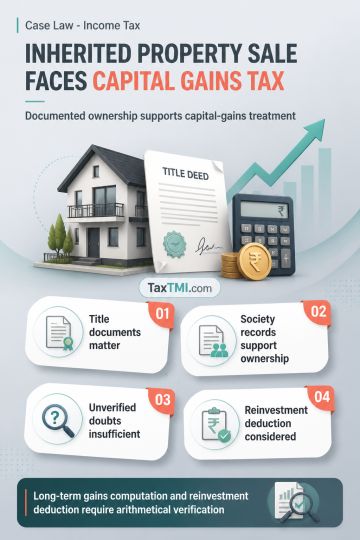
Inherited property sale proceeds require capital-gains treatment where ownership is supported by evidence, not suspicion or unverified signature doubt...
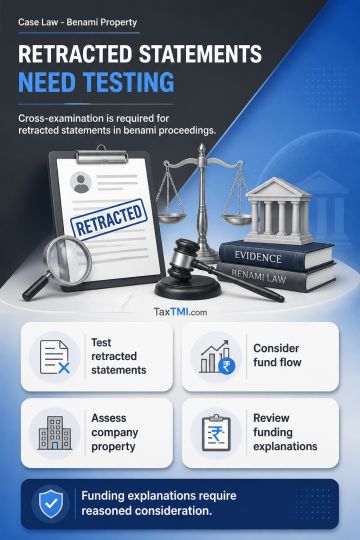
Cross-examination of retracted statements is essential where foundational evidence supports a benami allegation and documented funding explanations re...
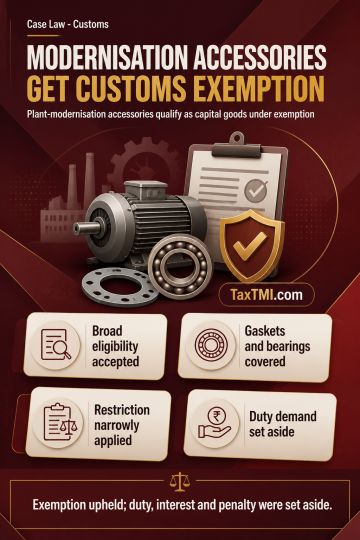
Capital-goods exemption covers plant-modernisation accessories, while the import restriction applies only to earlier capital-goods components and spar...
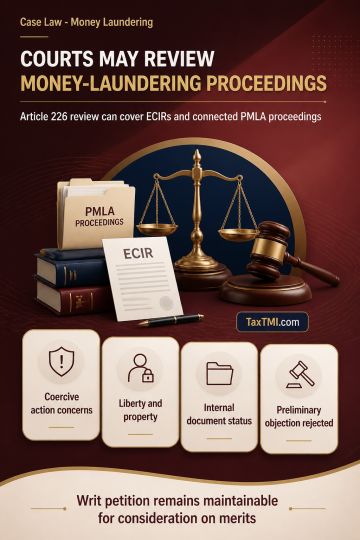
Constitutional judicial review permits challenges to ECIRs and connected money-laundering proceedings where coercive action affects fundamental intere...
The AAAR dismissed the appeal and held that import IGST paid via TR-6 challan is not an admissible document for claiming ITC because a TR-6 is a Treasury payment instrument and not a "bill of entry or any similar document" prescribed under the Customs Act or rules; consequently TR-6 (alone or read with SVB orders/letters) cannot support ITC. A re-assessed bill of entry, however, constitutes a prescribed document under r.36(1)(d) and thus may permit ITC, but such availment is governed by the time-bar in s.16(4) CGST, applied to IGST claims by s.20 IGST Act mutatis mutandis. Appeal dismissed.
The AAAR dismissed the appeal and held that import IGST paid via TR-6 challan is not an admissible document for claiming ITC because a TR-6 is a Treasury payment instrument and not a "bill of entry or any similar document" prescribed under the Customs Act or rules; consequently TR-6 (alone or read with SVB orders/letters) cannot support ITC. A re-assessed bill of entry, however, constitutes a prescribed document under r.36(1)(d) and thus may permit ITC, but such availment is governed by the time-bar in s.16(4) CGST, applied to IGST claims by s.20 IGST Act mutatis mutandis. Appeal dismissed.
Note: It is a system-generated summary and is for quick reference only.
 TaxTMI
 of 4792




 Join Channel


 TaxTMI