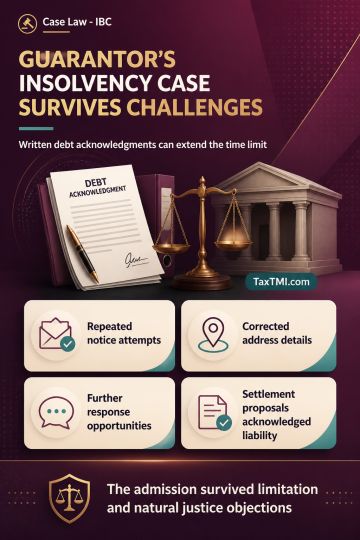
Service of notice and contractual debt acknowledgment preserved insolvency admission against a corporate guarantor despite limitation and natural just...
Original works exemption excludes standalone boulder transportation, leaving subcontracted railway-project transport services subject to service tax l...
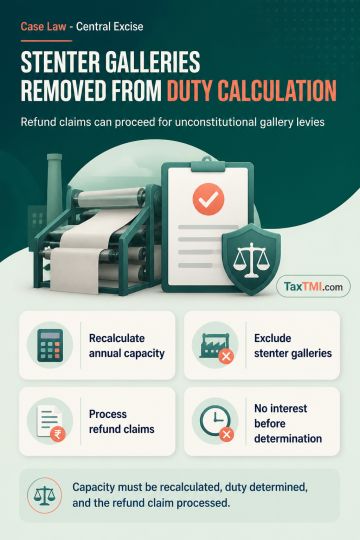
Annual production capacity determinations excluding stenter galleries support refunds for unconstitutional excise levies without an unjust-enrichment ...
Vicarious liability for cheque dishonour requires specific allegations of responsibility and cheque signatory; generic director allegations cannot sus...
IT Resilience Index requires market infrastructure institutions to automate resilience scoring, early warnings, and continuous service-delivery monito...
The HC dismissed the petition. It held that the RDDB Act constitutes a self-contained recovery code and Rule 68B of the Second Schedule to the IT Act does not apply mandatorily to RDDB proceedings; therefore no separate three-/four-/seven-year bar can be imported into recovery actions under the RDDB Act. Jurisdiction to execute arises after the recovery certificate attains finality under ss.19 and 25, and limitation for recovery proceedings is governed by Article 136 of the Limitation Act. Sales conducted beyond the aspirational time-limits are irregular but not void; decrees affected by such defects must be assailed by appropriate appellate or review remedies, and constructive res judicata precludes collateral relitigation.
The HC dismissed the petition. It held that the RDDB Act constitutes a self-contained recovery code and Rule 68B of the Second Schedule to the IT Act does not apply mandatorily to RDDB proceedings; therefore no separate three-/four-/seven-year bar can be imported into recovery actions under the RDDB Act. Jurisdiction to execute arises after the recovery certificate attains finality under ss.19 and 25, and limitation for recovery proceedings is governed by Article 136 of the Limitation Act. Sales conducted beyond the aspirational time-limits are irregular but not void; decrees affected by such defects must be assailed by appropriate appellate or review remedies, and constructive res judicata precludes collateral relitigation.
Note: It is a system-generated summary and is for quick reference only.
 TaxTMI
  TaxTMI
 of 4828












 Join Channel