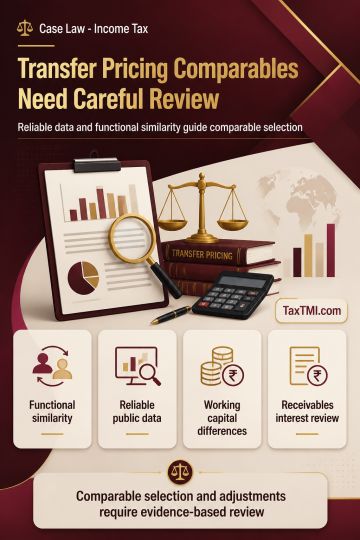
Transfer pricing comparability requires functional alignment, reliable financial data, and careful review of working capital and receivables adjustmen...
Transfer pricing rules require benchmarking corporate guarantees and associated-enterprise advances, while invalid domestic-transaction adjustments ca...
Prospective sugar export prohibition required registered letters of credit; private contracts and export quotas created no enforceable continuation ri...
Retroactive interim-moratorium exclusion permits protective asset disclosure and preservation measures against personal guarantors pending arbitration...
Page of 4798
Press 'Enter' after typing page number.
461 to 480 of 95957 Results
❮
❯
❯❯
0 / 200
Expand Note
Add to Folder
No Folders have been created
+
Are you sure you want to delete "My most important" ?
ITAT finds the impugned CIT(A) order to be cryptic and nonspeaking, lacking independent findings and adequate application of mind to the assessee's submissions and bank records; it also records the AO's failure, without satisfactory explanation, to file the remand report despite two opportunities. Noting absence of evidence for the revenue's asserted reasons for non-compliance, and that the AO proceeded to assess under section 144 without full compliance by the assessee, ITAT sets aside the CIT(A) order and remands the matter to the AO for fresh adjudication. AO is directed to examine the additional evidence produced by the assessee, obtain any necessary bank records, and decide the matter on merits.
ITAT finds the impugned CIT(A) order to be cryptic and nonspeaking, lacking independent findings and adequate application of mind to the assessee's submissions and bank records; it also records the AO's failure, without satisfactory explanation, to file the remand report despite two opportunities. Noting absence of evidence for the revenue's asserted reasons for non-compliance, and that the AO proceeded to assess under section 144 without full compliance by the assessee, ITAT sets aside the CIT(A) order and remands the matter to the AO for fresh adjudication. AO is directed to examine the additional evidence produced by the assessee, obtain any necessary bank records, and decide the matter on merits.
Note: It is a system-generated summary and is for quick reference only.
 TaxTMI
 of 4798















 Join Channel


 TaxTMI