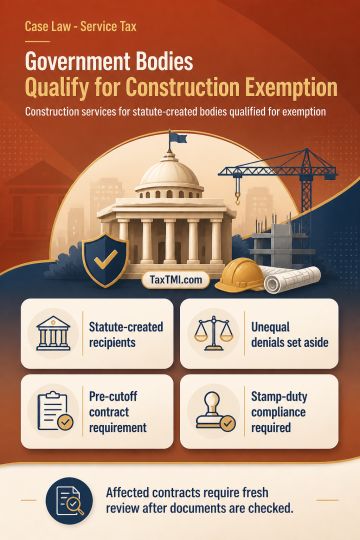
Governmental authority status supports construction-service exemption, while pre-cutoff contract and stamp-duty compliance requires verification on re...
Automated Free Sale and Commerce Certificates enable paperless processing while retaining risk-based manual verification for selected exporter applica...
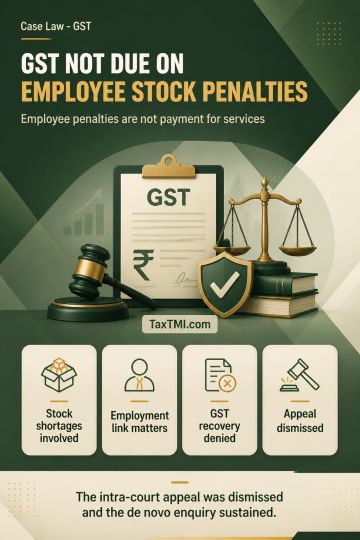
Employee stock-shortage penalties do not constitute consideration for services, preventing GST collection under Schedule II in employment relationship...
The ITAT allowed the appellant's appeal, set aside the orders of the lower authorities and directed that tax be computed at normal slab rates rather than the maximum marginal rate. The Tribunal held that the entity, being an unregistered religious trust for the relevant year and having filed Form-5 declaring income of Rs.1,50,272, fell within the threshold exemption of Rs.2,50,000 applicable to an AOP of its class; therefore section 164(2) (invoking MMR) was inapplicable. Section 164(3)(a) governs the present facts. The CPC's levy of MMR was held erroneous and all grounds raised by the appellant were allowed.
The ITAT allowed the appellant's appeal, set aside the orders of the lower authorities and directed that tax be computed at normal slab rates rather than the maximum marginal rate. The Tribunal held that the entity, being an unregistered religious trust for the relevant year and having filed Form-5 declaring income of Rs.1,50,272, fell within the threshold exemption of Rs.2,50,000 applicable to an AOP of its class; therefore section 164(2) (invoking MMR) was inapplicable. Section 164(3)(a) governs the present facts. The CPC's levy of MMR was held erroneous and all grounds raised by the appellant were allowed.
Note: It is a system-generated summary and is for quick reference only.
 TaxTMI
  TaxTMI
 of 4827











 Join Channel


