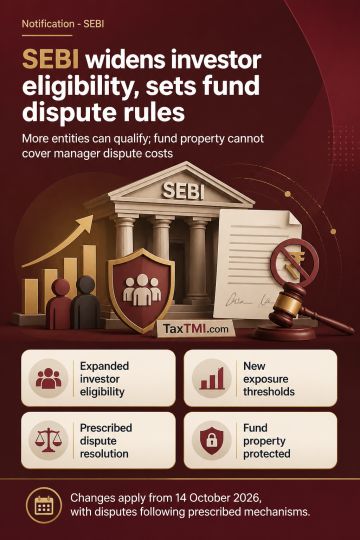
Accredited investor eligibility expands through securities-market exposure, while alternative investment fund disputes require prescribed resolution a...
Customs Assessment Portal centralises classification and valuation guidance to support consistent, transparent and informed compliance across stakehol...
GST refunds for cancelled air tickets remain available when passenger reimbursements defeat unjust enrichment and credit-note adjustment is unavailabl...
HC held that penalty under Section 50 of the FERA is not sustainable against the appellants. Reading Section 18(1)(a) with Sections 18(2) and 18(3) and the attendant notification, the Court found that non-realisation of a small percentage (~5.45%) of export proceeds did not warrant automatic penal liability where prescribed procedural requisites and reasonable steps are considered. The appellants were entitled to write-off of unrealised export bills in line with post-liberalisation RBI practice; the AD had sought write-off and the RBI failed to implement the applicable circular. The appellants had also reversed proportionate duty drawback, negating misuse of export incentives, supporting relief from penalty.
HC held that penalty under Section 50 of the FERA is not sustainable against the appellants. Reading Section 18(1)(a) with Sections 18(2) and 18(3) and the attendant notification, the Court found that non-realisation of a small percentage (~5.45%) of export proceeds did not warrant automatic penal liability where prescribed procedural requisites and reasonable steps are considered. The appellants were entitled to write-off of unrealised export bills in line with post-liberalisation RBI practice; the AD had sought write-off and the RBI failed to implement the applicable circular. The appellants had also reversed proportionate duty drawback, negating misuse of export incentives, supporting relief from penalty.
Note: It is a system-generated summary and is for quick reference only.
 TaxTMI
  TaxTMI
 of 4920