GST refunds for cancelled air tickets remain available when passenger reimbursements defeat unjust enrichment and credit-note adjustment is unavailabl...
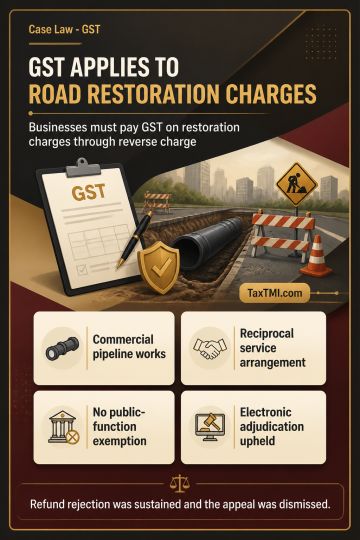
Request-driven road restoration attracts reverse-charge GST, not governmental-function treatment or compensatory-damages status for business recipient...
Road restoration charges for commercial pipeline works are taxable Government services, with reverse charge liability and no public-function exemption...
The HC dismissed the Revenue's appeal and upheld the CESTAT's finding that the assessee did not willfully suppress material facts to invoke the proviso to s.11A(1) of the Central Excise Act for an extended limitation period. The court concluded that both Revenue and the assessee had knowledge of the draw-warping activities, and the assessee's reliance on a notification did not amount to fraud, misrepresentation or willful concealment. Consequently, the show cause notice issued beyond the normal limitation was time-barred, and the CESTAT correctly set aside demands predicated on the extended period; substantial questions of law were answered for the assessee and against the Revenue.
The HC dismissed the Revenue's appeal and upheld the CESTAT's finding that the assessee did not willfully suppress material facts to invoke the proviso to s.11A(1) of the Central Excise Act for an extended limitation period. The court concluded that both Revenue and the assessee had knowledge of the draw-warping activities, and the assessee's reliance on a notification did not amount to fraud, misrepresentation or willful concealment. Consequently, the show cause notice issued beyond the normal limitation was time-barred, and the CESTAT correctly set aside demands predicated on the extended period; substantial questions of law were answered for the assessee and against the Revenue.
Note: It is a system-generated summary and is for quick reference only.
 TaxTMI
  TaxTMI
 of 4920