GST refunds for cancelled air tickets remain available when passenger reimbursements defeat unjust enrichment and credit-note adjustment is unavailabl...
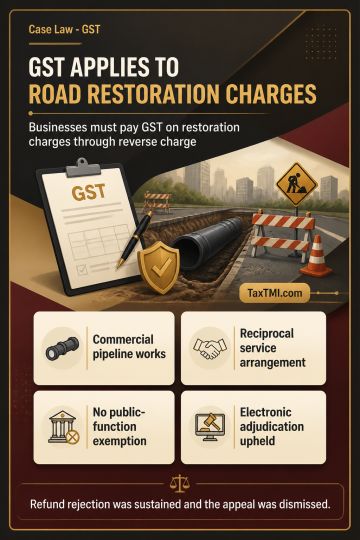
Request-driven road restoration attracts reverse-charge GST, not governmental-function treatment or compensatory-damages status for business recipient...
Road restoration charges for commercial pipeline works are taxable Government services, with reverse charge liability and no public-function exemption...
The ITAT allowed the assessee's claim for deduction under section 80JJAA, holding that the delayed filing of revised Form 10DA during assessment proceedings constituted a procedural lapse and could not alone defeat substantive entitlement. Citing precedent of the HC and coordinate benches, the Tribunal observed that initial non-filing before the return due date is a procedural omission; therefore the Assessing Officer should not deny the deduction solely on that ground. As the lower authorities did not examine the correctness of the claim, the ITAT remitted the matter to the AO for limited verification and quantification of the allowable deduction, directing compliance with applicable procedural safeguards.
The ITAT allowed the assessee's claim for deduction under section 80JJAA, holding that the delayed filing of revised Form 10DA during assessment proceedings constituted a procedural lapse and could not alone defeat substantive entitlement. Citing precedent of the HC and coordinate benches, the Tribunal observed that initial non-filing before the return due date is a procedural omission; therefore the Assessing Officer should not deny the deduction solely on that ground. As the lower authorities did not examine the correctness of the claim, the ITAT remitted the matter to the AO for limited verification and quantification of the allowable deduction, directing compliance with applicable procedural safeguards.
Note: It is a system-generated summary and is for quick reference only.
 TaxTMI
  TaxTMI
 of 4920