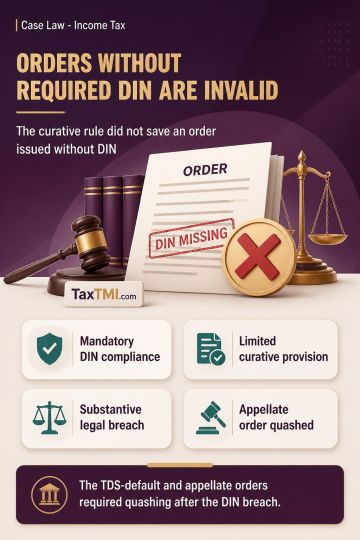
Document Identification Number compliance renders TDS-default orders invalid where mandatory DIN requirements are breached and curative provision does...
The HC dismissed the petition and upheld the Respondent's refusal to effect mutation, holding the refusal lawful, reasonable and within the statutory scheme. The court ruled that municipal property tax creates a statutory charge on the asset which the authority may enforce through its statutory mechanism; such dues are not displaced by insolvency proceedings. An auction purchaser may be saddled with pre-sale statutory liabilities if the purchaser was or ought to have been put on notice; where the sale notice and EOI required bidders to conduct due diligence, the successful auction purchaser is liable for outstanding property tax as an encumbrance. The challenge to the corporation's denial of mutation was therefore rejected.
The HC dismissed the petition and upheld the Respondent's refusal to effect mutation, holding the refusal lawful, reasonable and within the statutory scheme. The court ruled that municipal property tax creates a statutory charge on the asset which the authority may enforce through its statutory mechanism; such dues are not displaced by insolvency proceedings. An auction purchaser may be saddled with pre-sale statutory liabilities if the purchaser was or ought to have been put on notice; where the sale notice and EOI required bidders to conduct due diligence, the successful auction purchaser is liable for outstanding property tax as an encumbrance. The challenge to the corporation's denial of mutation was therefore rejected.
Note: It is a system-generated summary and is for quick reference only.
 TaxTMI
  TaxTMI
 of 4918