Transfer pricing and tax deductions upheld on established principles, while employee contributions and warranty provisions returned for fresh examinat...
Captive transfer pricing relies on industrial consumer tariffs, while genuine quotations can benchmark effluent treatment transfers under the Other Me...
Specific tariff classification for ophthalmic instruments and extended limitation principles determine the treatment of duty demands, confiscation, an...
Integrated golf function determines classification, placing launch monitors and simulators under other golf equipment rather than measuring instrument...
Public servant status under anti-corruption law extends to recognised stock exchange leadership; constitutional and sanction challenges do not succeed...
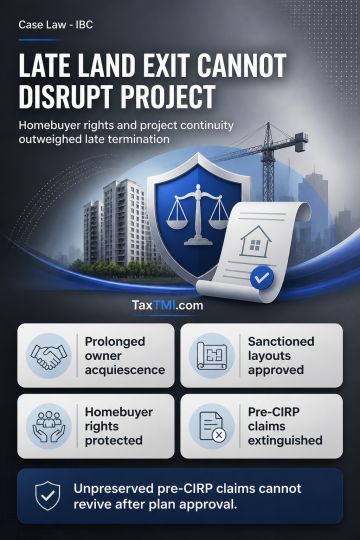
Acquiescence, homebuyer protection and clean-slate resolution principles prevent landowners from disrupting an integrated project through late termina...
HC held that the joint venture development agreement dated 21.12.2005 was not legally effective as against the assessee firm because the partnership deed post-dating that agreement vested legal status in the firm only from 29.11.2007; consequently the firm could not substantively include investments made prior to its constitution. The Court found the assessee failed to discharge the onus of proving it acted as developer or produced requisite books, bills and vouchers, allowing the Assessing Officer's adverse inferences. Although planning approval/completion certificates in another entity's name do not per se defeat a s.80IB(10) claim, on the facts the Tribunal's acceptance was set aside, AO and CIT(A) orders restored, and the assessee held ineligible for deduction under s.80IB(10).
HC held that the joint venture development agreement dated 21.12.2005 was not legally effective as against the assessee firm because the partnership deed post-dating that agreement vested legal status in the firm only from 29.11.2007; consequently the firm could not substantively include investments made prior to its constitution. The Court found the assessee failed to discharge the onus of proving it acted as developer or produced requisite books, bills and vouchers, allowing the Assessing Officer's adverse inferences. Although planning approval/completion certificates in another entity's name do not per se defeat a s.80IB(10) claim, on the facts the Tribunal's acceptance was set aside, AO and CIT(A) orders restored, and the assessee held ineligible for deduction under s.80IB(10).
Note: It is a system-generated summary and is for quick reference only.
 TaxTMI
 of 4803














 Join Channel


 TaxTMI