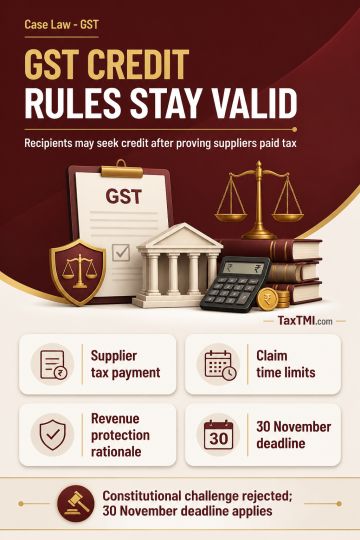
Input tax credit conditions remain constitutionally valid, with eligible recipient claims considered under GST circulars and retrospective filing dead...
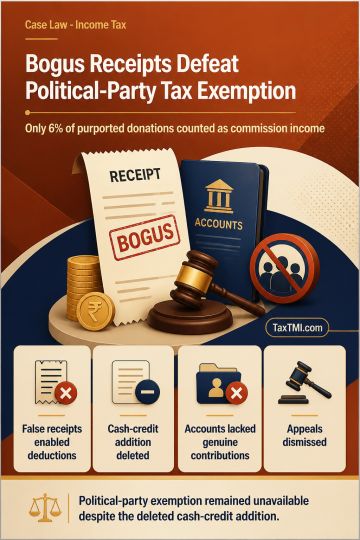
Bogus donation receipts justified commission income assessment and defeated political-party tax exemption for inaccurate accounts and reporting failur...
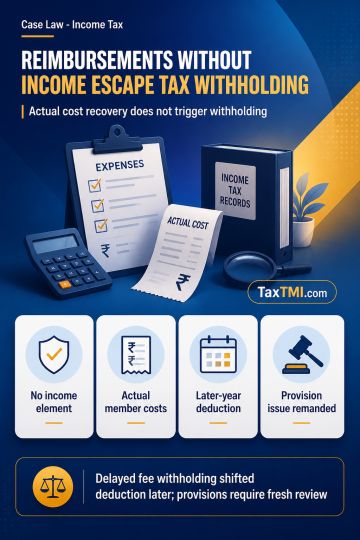
Pure reimbursement without income element escapes tax withholding, while delayed withholding and unsupported provisions face deferred or renewed scrut...
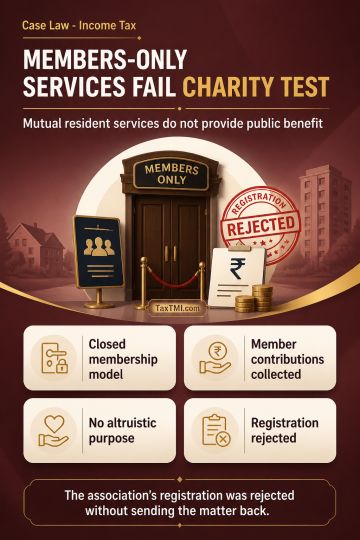
Public benefit requirement defeats charitable registration where residents' association services are reciprocal, member-only facilities governed by mu...
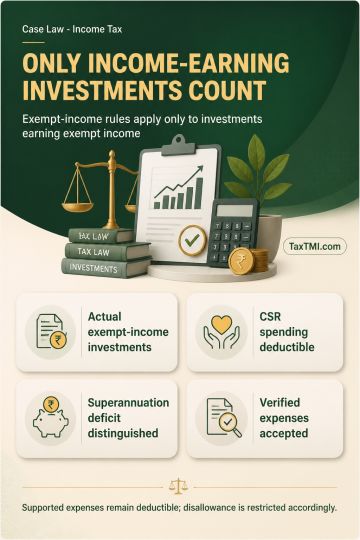
Exempt-income expenditure disallowance is confined to investments that actually generated exempt income, while supported business expenses remain dedu...
Page of 4796
Press 'Enter' after typing page number.
621 to 640 of 95918 Results
❮
❯
❯❯
0 / 200
Expand Note
Add to Folder
No Folders have been created
+
Are you sure you want to delete "My most important" ?
HC held that income derived from production and sale of hybrid seeds qualified as agricultural income within s.10(1) because the appellant, although not directly tilling land, exercised supervision, technical guidance, contractual control and bore risk and expense of cultivation carried out by farmers to produce parent and hybrid seeds. The Court concluded the operations constituted agricultural activity carried out through contractors, establishing a direct nexus with land. Accordingly, the HC allowed the appellant's appeal, treating the receipts as exempt agricultural income and reversing the characterization that disallowed exemption, while recognising the legitimacy of production-by-contract and the appellant's effective control over cultivation.
HC held that income derived from production and sale of hybrid seeds qualified as agricultural income within s.10(1) because the appellant, although not directly tilling land, exercised supervision, technical guidance, contractual control and bore risk and expense of cultivation carried out by farmers to produce parent and hybrid seeds. The Court concluded the operations constituted agricultural activity carried out through contractors, establishing a direct nexus with land. Accordingly, the HC allowed the appellant's appeal, treating the receipts as exempt agricultural income and reversing the characterization that disallowed exemption, while recognising the legitimacy of production-by-contract and the appellant's effective control over cultivation.
Note: It is a system-generated summary and is for quick reference only.
 TaxTMI
 of 4796










 Join Channel


 TaxTMI