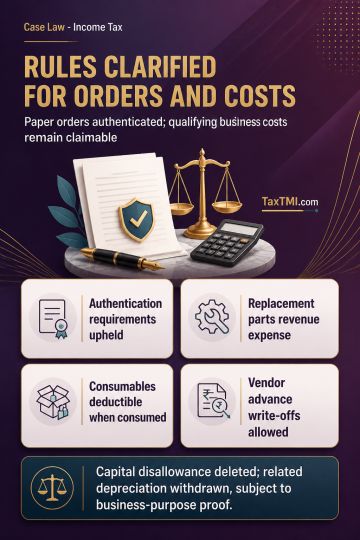
Authentication of paper assessment orders upheld, while qualifying repairs, consumables and vendor advance write-offs remain deductible business claim...
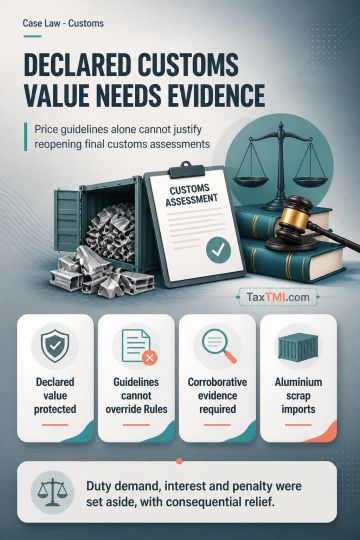
Transaction value cannot be rejected solely on non-statutory valuation guidelines without corroborative evidence supporting reassessment of final cust...
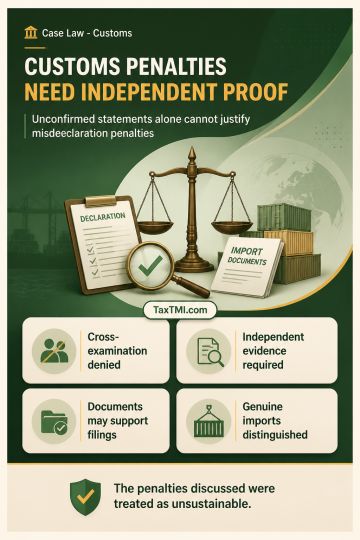
Cross-examination rights and corroborated evidence limit customs penalties for misdeclaration in genuine import transactions involving documented clea...
Page of 4796
Press 'Enter' after typing page number.
581 to 600 of 95916 Results
❮
❯
❯❯
0 / 200
Expand Note
Add to Folder
No Folders have been created
+
Are you sure you want to delete "My most important" ?
HC held that income derived from production and sale of hybrid seeds qualified as agricultural income within s.10(1) because the appellant, although not directly tilling land, exercised supervision, technical guidance, contractual control and bore risk and expense of cultivation carried out by farmers to produce parent and hybrid seeds. The Court concluded the operations constituted agricultural activity carried out through contractors, establishing a direct nexus with land. Accordingly, the HC allowed the appellant's appeal, treating the receipts as exempt agricultural income and reversing the characterization that disallowed exemption, while recognising the legitimacy of production-by-contract and the appellant's effective control over cultivation.
HC held that income derived from production and sale of hybrid seeds qualified as agricultural income within s.10(1) because the appellant, although not directly tilling land, exercised supervision, technical guidance, contractual control and bore risk and expense of cultivation carried out by farmers to produce parent and hybrid seeds. The Court concluded the operations constituted agricultural activity carried out through contractors, establishing a direct nexus with land. Accordingly, the HC allowed the appellant's appeal, treating the receipts as exempt agricultural income and reversing the characterization that disallowed exemption, while recognising the legitimacy of production-by-contract and the appellant's effective control over cultivation.
Note: It is a system-generated summary and is for quick reference only.
 TaxTMI
 of 4796










 Join Channel


 TaxTMI