Cooperative society deposits, member-interest TDS exemption and credit-facility deduction claims require verification through records and supporting e...
Customs jurisdiction over EPCG condition breaches survives export-obligation discharge certificates, requiring alleged fraud and misdeclaration to be ...
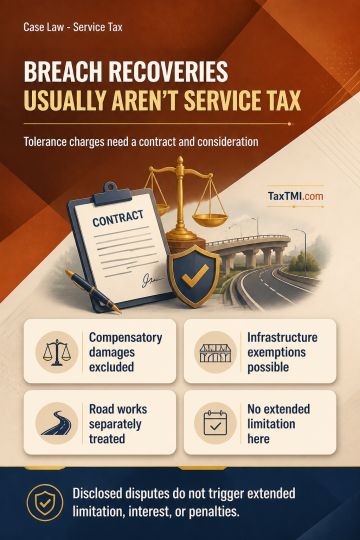
Contractual tolerance requires consideration; breach recoveries, qualifying public infrastructure services and road works escape service tax liability...
The SC allowed the appeal, set aside the HC's order and restored the execution court's position, holding that the arbitral award-drafted in conformity with the parties' MoU-did not grant compound interest and accordingly cannot be supplemented at execution. Under s.31(7)(a)/(b) of the Arbitration and Conciliation Act, party autonomy governs interest from cause of action to award date and the tribunal's discretion under clause (a) exists only in the absence of contrary agreement; clause (b) is contingent on an award. Because the tribunal awarded interest only until repayment and the MoU did not provide for compounding, the respondent's claim for compound interest in execution was rejected.
The SC allowed the appeal, set aside the HC's order and restored the execution court's position, holding that the arbitral award-drafted in conformity with the parties' MoU-did not grant compound interest and accordingly cannot be supplemented at execution. Under s.31(7)(a)/(b) of the Arbitration and Conciliation Act, party autonomy governs interest from cause of action to award date and the tribunal's discretion under clause (a) exists only in the absence of contrary agreement; clause (b) is contingent on an award. Because the tribunal awarded interest only until repayment and the MoU did not provide for compounding, the respondent's claim for compound interest in execution was rejected.
Note: It is a system-generated summary and is for quick reference only.
 TaxTMI
 of 4798










 Join Channel


 TaxTMI