TNMM functional comparability requires excluding rice manufacturers from a pure Basmati rice trader's benchmark and recognising operating export recei...
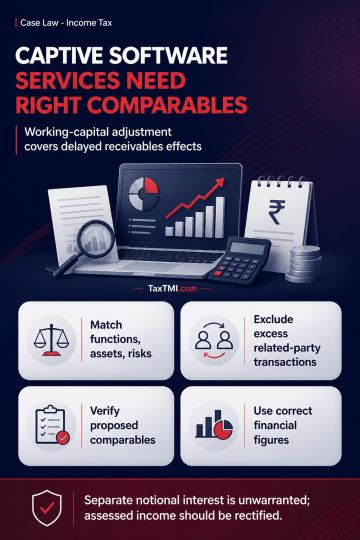
Working-capital adjustment subsumes delayed-receivable effects in TNMM benchmarking of captive software-development services, avoiding separate notion...
Transfer-pricing comparability requires exclusion of financially illogical super-profit comparables and correction of unsupported annual-report and ma...
Charitable character assessment preserves Section 80G approval despite inclusive spiritual teachings and incidental religious expenditure within the s...
Penalty proceedings for cash-loan acceptance require assessment proceedings and recorded Assessing Officer satisfaction; absent these, the proceedings...
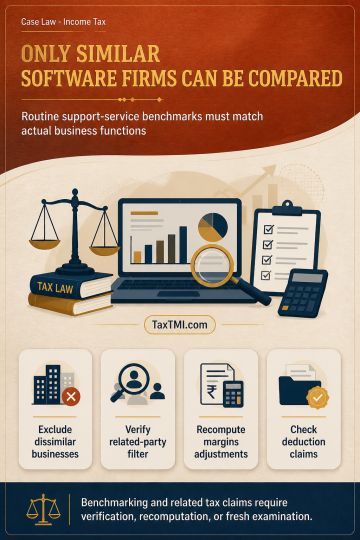
Functional comparability governs software-service benchmarking: dissimilar companies are excluded, while related-party filters, margins and working-ca...
CESTAT held that while the impugned goods supplied to the Railways were marketable and not entitled to a government-company exemption, the adjudicating authority erred in invoking Valuation Rules (notably Rules 11 and 8) without adequate reasoning and in disregarding the appellants' CAS-4 cost records. The Tribunal found the valuation adjustments and differential duty computation unsustainable because the authority failed to explain why the appellants' declared value was incorrect and did not properly apply s.4(1) principles. Consequently the impugned orders were set aside, differential duty was not sustained, and penalties were held unwarranted. Both appeals were allowed in favour of the appellants.
CESTAT held that while the impugned goods supplied to the Railways were marketable and not entitled to a government-company exemption, the adjudicating authority erred in invoking Valuation Rules (notably Rules 11 and 8) without adequate reasoning and in disregarding the appellants' CAS-4 cost records. The Tribunal found the valuation adjustments and differential duty computation unsustainable because the authority failed to explain why the appellants' declared value was incorrect and did not properly apply s.4(1) principles. Consequently the impugned orders were set aside, differential duty was not sustained, and penalties were held unwarranted. Both appeals were allowed in favour of the appellants.
Note: It is a system-generated summary and is for quick reference only.
 TaxTMI
  TaxTMI
 of 4830



















 Join Channel


