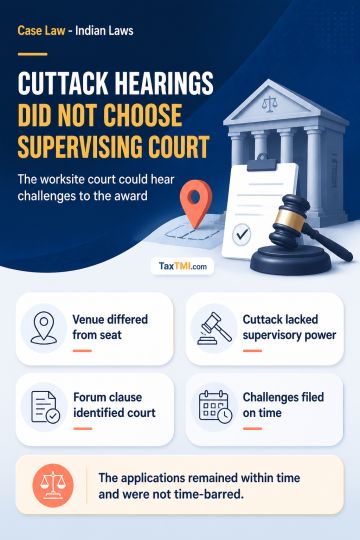
Juridical seat versus arbitral venue determines supervisory court jurisdiction, while timely award challenges remain within the prescribed limitation ...
The AAR held that the applicant is entitled to claim input tax credit of IGST paid on import of goods even where payment to the foreign supplier was deferred beyond 180 days from invoice but made within FEMA/RBI timelines. The Authority concluded that such ITC remains admissible under Section 16 of the CGST Act, 2017 and is not liable to reversal under the second proviso to Section 16(2) read with Rule 37, since IGST was discharged at customs thereby protecting revenue and creating a situation analogous to reverse charge supplies (which fall under the proviso's exclusion). The decision rests on legislative intent reflected in GST Council recommendations.
The AAR held that the applicant is entitled to claim input tax credit of IGST paid on import of goods even where payment to the foreign supplier was deferred beyond 180 days from invoice but made within FEMA/RBI timelines. The Authority concluded that such ITC remains admissible under Section 16 of the CGST Act, 2017 and is not liable to reversal under the second proviso to Section 16(2) read with Rule 37, since IGST was discharged at customs thereby protecting revenue and creating a situation analogous to reverse charge supplies (which fall under the proviso's exclusion). The decision rests on legislative intent reflected in GST Council recommendations.
Note: It is a system-generated summary and is for quick reference only.
 TaxTMI
  TaxTMI
 of 4886