Governmental authority status supports construction-service exemption, while pre-cutoff contract and stamp-duty compliance requires verification on re...
Automated Free Sale and Commerce Certificates enable paperless processing while retaining risk-based manual verification for selected exporter applica...
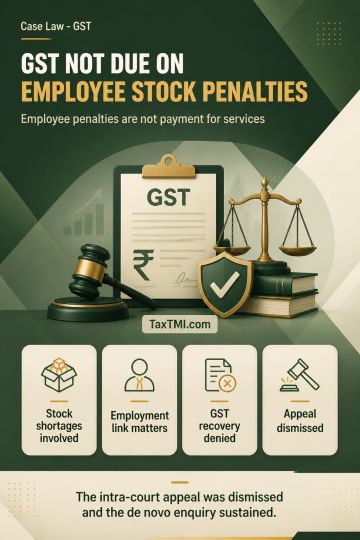
Employee stock-shortage penalties do not constitute consideration for services, preventing GST collection under Schedule II in employment relationship...
The ITAT held that penalty proceedings under s.271(1)(c) read with s.274 were vitiated where the AO's notice failed to specify which limb of s.271(1)(c) (concealment of particulars or furnishing of inaccurate particulars/under-reporting or misreporting) was invoked and did not strike out the irrelevant portion of the charge. Applying the controlling full-bench ratio, the Tribunal concluded that procedural infirmity deprived the assessee of fair notice; accordingly the penalty orders framed by the AO under s.271(1)(c) were held invalid and were quashed, with the appeal allowed in favour of the assessee.
The ITAT held that penalty proceedings under s.271(1)(c) read with s.274 were vitiated where the AO's notice failed to specify which limb of s.271(1)(c) (concealment of particulars or furnishing of inaccurate particulars/under-reporting or misreporting) was invoked and did not strike out the irrelevant portion of the charge. Applying the controlling full-bench ratio, the Tribunal concluded that procedural infirmity deprived the assessee of fair notice; accordingly the penalty orders framed by the AO under s.271(1)(c) were held invalid and were quashed, with the appeal allowed in favour of the assessee.
Note: It is a system-generated summary and is for quick reference only.
 TaxTMI
  TaxTMI
 of 4828














 Join Channel


