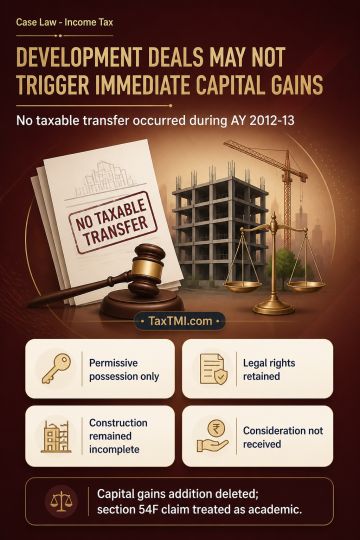
Development agreements require legal possession or effective enjoyment for capital gains transfer; permissive possession and deferred consideration de...
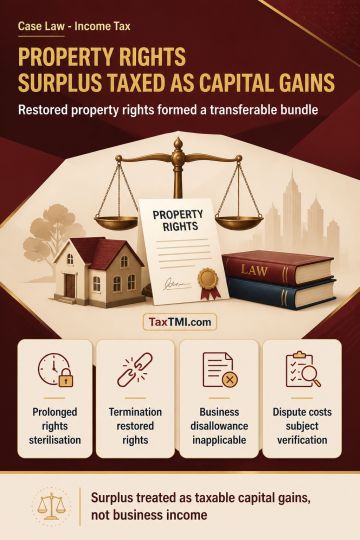
Prolonged sterilisation of development rights supports capital-gains treatment, while business-income disallowances cannot govern capital-gains comput...
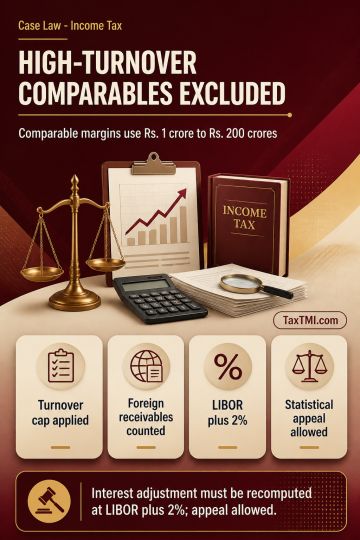
Additional evidence in transfer pricing dispute leads to fresh examination, while tax deductions, TDS credit, fee and refund interest require verifica...
Category II AIF pass-through taxation preserves non-business income character; investment receipts cannot be reclassified without applying recognised ...
AAR held that consultation services and medicines dispensed to...
Consultation services and out-patient medicines are separate taxable supplies; in-patient supplies remain exempt composite health-care supply under GST
Contents
Summary
Note
Bookmark
Share
✓ Copied successfully !
Print
Print Options
For full text, please login
Login to TaxTMI
Verification Pending
The Email Id has not been verified. Click on the link we have sent on
AAR held that consultation services and medicines dispensed to out-patients constitute distinct taxable supplies rather than a composite supply; medicines and consumables prescribed to out-patients are independent of the exempt health-care service and therefore subject to GST, whereas supplies integral to treatment of in-patients (including pharmacy-issued medicines and prescribed food) form part of the exempt composite health-care supply. Consequently, supplies to out-patients must be treated and invoiced as separate taxable supplies from the professional medical service, and are not subsumed under the exemption applicable to in-patient care.
AAR held that consultation services and medicines dispensed to out-patients constitute distinct taxable supplies rather than a composite supply; medicines and consumables prescribed to out-patients are independent of the exempt health-care service and therefore subject to GST, whereas supplies integral to treatment of in-patients (including pharmacy-issued medicines and prescribed food) form part of the exempt composite health-care supply. Consequently, supplies to out-patients must be treated and invoiced as separate taxable supplies from the professional medical service, and are not subsumed under the exemption applicable to in-patient care.
Note: It is a system-generated summary and is for quick reference only.
 TaxTMI
  TaxTMI
 of 4807









 Join Channel


