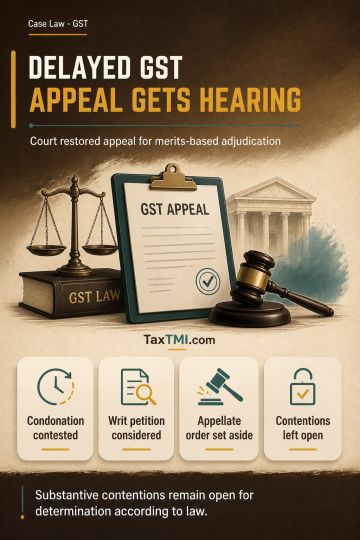
Necessary-party requirements limit impleadment of independent entities, while deferred consideration does not create an appealable adverse determinati...
Food supplement classification requires common parlance and authoritative tests, preventing treatment as proprietary Ayurvedic medicines without suppo...
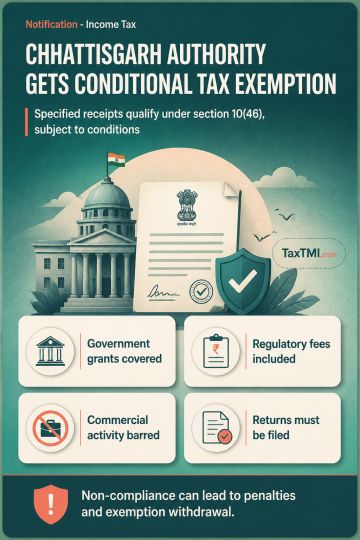
Specified regulatory authority income receives conditional tax exemption, subject to non-commercial activity, unchanged income character, and return f...
Tax exemption for regulatory authority income applies retrospectively, subject to non-commercial activity, unchanged income sources, and return-filing...
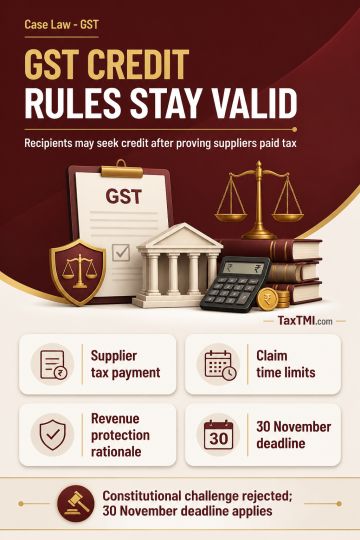
Input tax credit conditions remain constitutionally valid, with eligible recipient claims considered under GST circulars and retrospective filing dead...
SC held that the impugned judgment is set aside and the appeal is allowed; the plaintiff's suit for possession, mesne profits, declaration and mandatory injunction is dismissed. The court ruled the Agreement to Sell, GPA, receipt and registered will did not confer proprietary title: an agreement for sale is not a deed of conveyance under Section 54 TP Act and at best entitles the transferee to seek specific performance. The registered will was not properly proved and cannot operate to vest title. The claimant cannot invoke Section 53A TP Act because there was no possession at suit filing. Rights of class-I heirs are preserved and parties may pursue statutory shares accordingly.
SC held that the impugned judgment is set aside and the appeal is allowed; the plaintiff's suit for possession, mesne profits, declaration and mandatory injunction is dismissed. The court ruled the Agreement to Sell, GPA, receipt and registered will did not confer proprietary title: an agreement for sale is not a deed of conveyance under Section 54 TP Act and at best entitles the transferee to seek specific performance. The registered will was not properly proved and cannot operate to vest title. The claimant cannot invoke Section 53A TP Act because there was no possession at suit filing. Rights of class-I heirs are preserved and parties may pursue statutory shares accordingly.
Note: It is a system-generated summary and is for quick reference only.
 TaxTMI
 of 4792



















 Join Channel


 TaxTMI