Form 26AS evidence requires successor-entity accounting verification after business transfer, while invoice-supported related-party advertising expend...
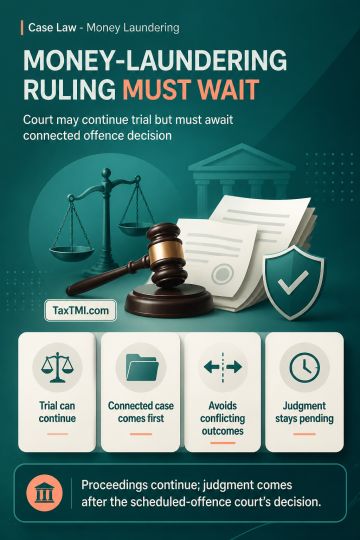
Money-laundering judgment timing requires awaiting the scheduled-offence decision despite continuation of the underlying trial where outcomes directly...
Accredited investor eligibility expands through securities-market exposure, while alternative investment fund disputes require prescribed resolution a...
Customs Assessment Portal centralises classification and valuation guidance to support consistent, transparent and informed compliance across stakehol...
Page of 4918
Press 'Enter' after typing page number.
101 to 120 of 98359 Results
❮
❯
❯❯
0 / 200
Expand Note
Add to Folder
No Folders have been created
+
Are you sure you want to delete "My most important" ?
The HC allowed the writ petition, setting aside the impugned order and quashing the penalty imposed under Section 129(1)(b) of the CGST Act as unsustainable. The court held the revenue accepted an unverified, uncorroborated statement from a third party as conclusive without issuing notice to or verifying representations of the appellants, and failed to conduct requisite verification of the genuineness of goods in transit and documents prior to issuance of the show-cause notice. Subsequent cancellation of the third party's registration, even if assumed, did not validate the departmental action. In consequence, the penalty and enforcement action against the appellants were declared illegal and were set aside.
The HC allowed the writ petition, setting aside the impugned order and quashing the penalty imposed under Section 129(1)(b) of the CGST Act as unsustainable. The court held the revenue accepted an unverified, uncorroborated statement from a third party as conclusive without issuing notice to or verifying representations of the appellants, and failed to conduct requisite verification of the genuineness of goods in transit and documents prior to issuance of the show-cause notice. Subsequent cancellation of the third party's registration, even if assumed, did not validate the departmental action. In consequence, the penalty and enforcement action against the appellants were declared illegal and were set aside.
Note: It is a system-generated summary and is for quick reference only.
 TaxTMI
  TaxTMI
 of 4918