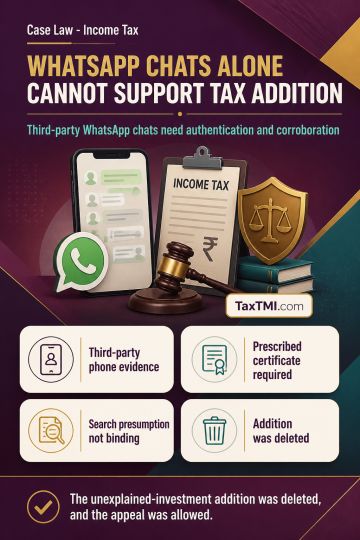
Electronic WhatsApp evidence without authentication or independent corroboration cannot sustain an unexplained-investment addition based on third-part...
Mutual current-account transactions excluded from deemed dividend treatment where no fresh borrowing arose; unsupported unsecured-loan addition also f...
The ITAT held that the assessee did not have a permanent establishment (PE) in India despite receiving royalty and technical service fees from its Indian subsidiary. Examination of the secondment agreement revealed that the seconded employees were under the exclusive control and supervision of the Indian entity, not the assessee. Consequently, the assessee lacked control over employees, assets, or any fixed place of business in India. The tribunal emphasized that under Article 5 of the India-Japan treaty, a PE requires a fixed place of business through which the non-resident carries on business, conditions unmet here. Therefore, the DRP and AO erred in concluding that the assessee had a PE in India. The appeal was allowed accordingly.
The ITAT held that the assessee did not have a permanent establishment (PE) in India despite receiving royalty and technical service fees from its Indian subsidiary. Examination of the secondment agreement revealed that the seconded employees were under the exclusive control and supervision of the Indian entity, not the assessee. Consequently, the assessee lacked control over employees, assets, or any fixed place of business in India. The tribunal emphasized that under Article 5 of the India-Japan treaty, a PE requires a fixed place of business through which the non-resident carries on business, conditions unmet here. Therefore, the DRP and AO erred in concluding that the assessee had a PE in India. The appeal was allowed accordingly.
Note: It is a system-generated summary and is for quick reference only.
 TaxTMI
  TaxTMI
 of 4828
















 Join Channel