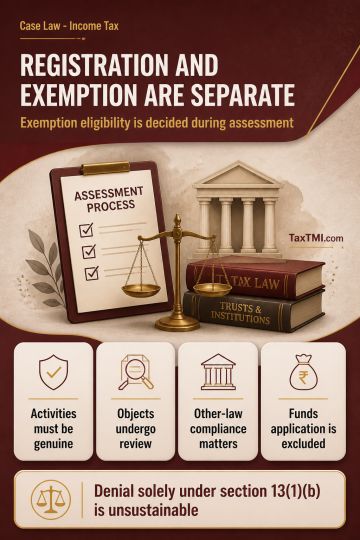
Defined public benefit can retain charitable character; registration renewal requires examining genuine activities and legal compliance, not surplus a...
Capital reduction is distinct from share buy-back, preventing buy-back tax; restructuring interest and related business deductions also survive scruti...
Transfer pricing and tax deductions upheld on established principles, while employee contributions and warranty provisions returned for fresh examinat...
Captive transfer pricing relies on industrial consumer tariffs, while genuine quotations can benchmark effluent treatment transfers under the Other Me...
Specific tariff classification for ophthalmic instruments and extended limitation principles determine the treatment of duty demands, confiscation, an...
Page of 4801
Press 'Enter' after typing page number.
1161 to 1180 of 96001 Results
❮
❯
❯❯
0 / 200
Expand Note
Add to Folder
No Folders have been created
+
Are you sure you want to delete "My most important" ?
The HC held that in the absence of any intent to evade tax, the imposition of a 200% penalty under Section 129(1) of the WBGST/CGST Act, 2017 for transporting goods without a valid e-way bill was unwarranted. The appellants' reasons for the e-way bill's expiration, which caused highway blockage, were neither disputed nor considered by the authorities. The court noted no dispute regarding the goods, their nature, or transport documents, deeming the case unsuitable for such a heavy penalty. While acknowledging the statutory requirement for a valid e-way bill, the court recognized mitigating circumstances for delay in renewal. Consequently, the penalty was reduced to a notional amount of Rs. 25,000. The appeal and writ petition were allowed, the original penalty order set aside, and the excess amount remitted by the appellants was ordered to be refunded within three weeks.
The HC held that in the absence of any intent to evade tax, the imposition of a 200% penalty under Section 129(1) of the WBGST/CGST Act, 2017 for transporting goods without a valid e-way bill was unwarranted. The appellants' reasons for the e-way bill's expiration, which caused highway blockage, were neither disputed nor considered by the authorities. The court noted no dispute regarding the goods, their nature, or transport documents, deeming the case unsuitable for such a heavy penalty. While acknowledging the statutory requirement for a valid e-way bill, the court recognized mitigating circumstances for delay in renewal. Consequently, the penalty was reduced to a notional amount of Rs. 25,000. The appeal and writ petition were allowed, the original penalty order set aside, and the excess amount remitted by the appellants was ordered to be refunded within three weeks.
Note: It is a system-generated summary and is for quick reference only.
 TaxTMI
 of 4801














 Join Channel


 TaxTMI

