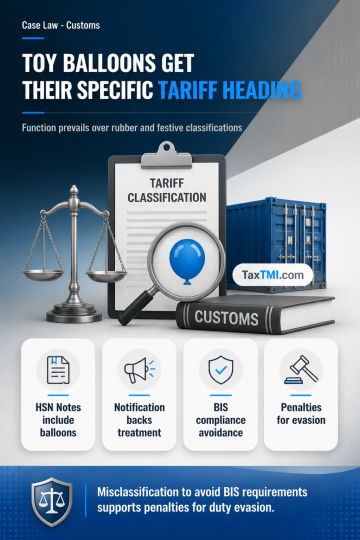
Toy balloon tariff classification: functional heading prevails over residual rubber and festive article headings, supporting penalties for deliberate ...
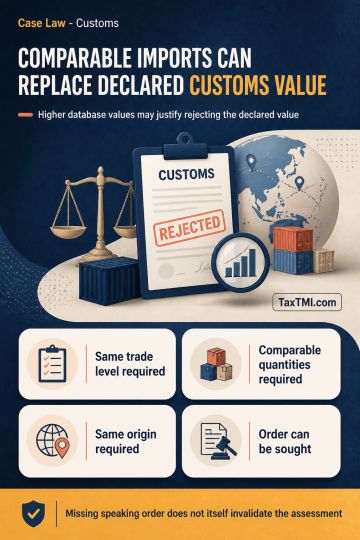
Customs valuation using comparable contemporaneous imports can displace declared value, while missing speaking orders require pursuit before competent...
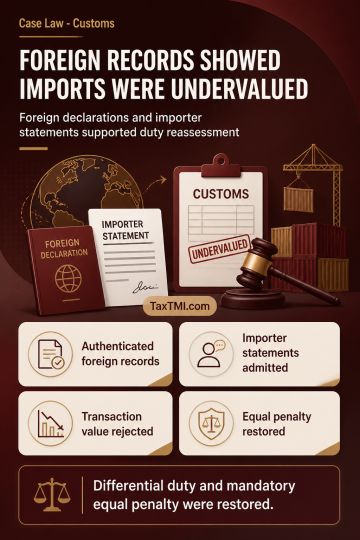
Foreign customs declarations and importer admissions established undervaluation, supporting sequential value redetermination, differential duty, and m...
Customs seizure safeguards prevent detention-based limitation avoidance and invalidate provisional release conditions for imported vehicles under an i...
Page of 4828
Press 'Enter' after typing page number.
361 to 380 of 96556 Results
❮
❯
❯❯
0 / 200
Expand Note
Add to Folder
No Folders have been created
+
Are you sure you want to delete "My most important" ?
The CESTAT set aside the penalties imposed under sections 112 and 114AA of the Customs Act, 1962, on the appellant for alleged violation related to export-bound gold jewellery. The Tribunal held that statements recorded under section 108 were inadmissible for penalty imposition under section 112, as procedural safeguards under section 138B were not followed, including the requirement for examination and cross-examination of witnesses. Regarding section 114AA, the penalty could not be sustained as there was no evidence the appellant knowingly furnished false or incorrect material, nor was the appellant involved in documentation or clearance processes. Consequently, the impugned order imposing penalties was quashed, and the appeal was allowed.
The CESTAT set aside the penalties imposed under sections 112 and 114AA of the Customs Act, 1962, on the appellant for alleged violation related to export-bound gold jewellery. The Tribunal held that statements recorded under section 108 were inadmissible for penalty imposition under section 112, as procedural safeguards under section 138B were not followed, including the requirement for examination and cross-examination of witnesses. Regarding section 114AA, the penalty could not be sustained as there was no evidence the appellant knowingly furnished false or incorrect material, nor was the appellant involved in documentation or clearance processes. Consequently, the impugned order imposing penalties was quashed, and the appeal was allowed.
Note: It is a system-generated summary and is for quick reference only.
 TaxTMI
  TaxTMI
 of 4828







 Join Channel