Development agreements require legal possession or effective enjoyment for capital gains transfer; permissive possession and deferred consideration de...
Prolonged sterilisation of development rights supports capital-gains treatment, while business-income disallowances cannot govern capital-gains comput...
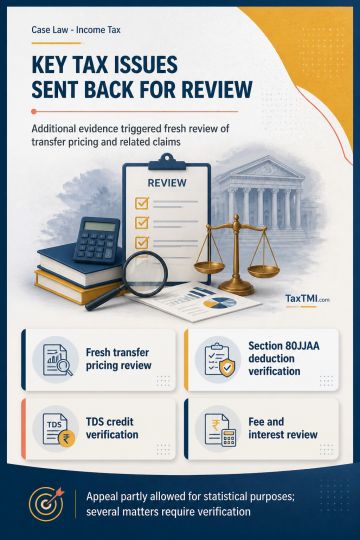
Additional evidence in transfer pricing dispute leads to fresh examination, while tax deductions, TDS credit, fee and refund interest require verifica...
Category II AIF pass-through taxation preserves non-business income character; investment receipts cannot be reclassified without applying recognised ...
The HC set aside the impugned orders of the Appellate Authority and the Proper Officer, holding that the timeline under Section 107(4) of the WBGST Act is directory, not mandatory, and the Limitation Act applies. The appellant demonstrated sufficient cause for condonation of delay in filing the appeal. The court found a violation of natural justice principles as the notice under Section 73(1) was improperly communicated via the Additional Tab instead of the Normal Tab, frustrating proper service and the opportunity for hearing mandated under Sections 73(9) and 75(4). The restrictive scope of intra-court appeal was not invoked due to the fundamental procedural lapses. The judgment of the Single Judge was held to contain a patent error of law in interpreting timelines strictly while ignoring mandatory hearing provisions, warranting interference. The writ petition was allowed, and the assessment order was quashed accordingly.
The HC set aside the impugned orders of the Appellate Authority and the Proper Officer, holding that the timeline under Section 107(4) of the WBGST Act is directory, not mandatory, and the Limitation Act applies. The appellant demonstrated sufficient cause for condonation of delay in filing the appeal. The court found a violation of natural justice principles as the notice under Section 73(1) was improperly communicated via the Additional Tab instead of the Normal Tab, frustrating proper service and the opportunity for hearing mandated under Sections 73(9) and 75(4). The restrictive scope of intra-court appeal was not invoked due to the fundamental procedural lapses. The judgment of the Single Judge was held to contain a patent error of law in interpreting timelines strictly while ignoring mandatory hearing provisions, warranting interference. The writ petition was allowed, and the assessment order was quashed accordingly.
Note: It is a system-generated summary and is for quick reference only.
 TaxTMI
 of 4805


















 Join Channel


 TaxTMI
