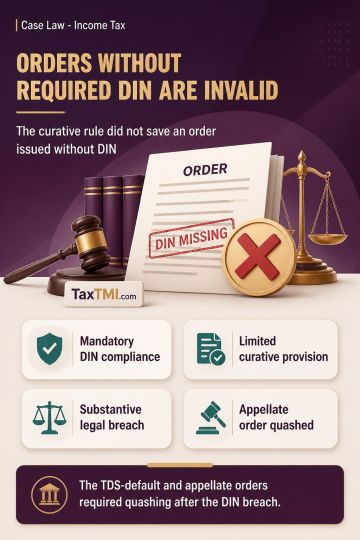
Document Identification Number compliance renders TDS-default orders invalid where mandatory DIN requirements are breached and curative provision does...
The ITAT held that the penalty notice issued under section 274 read with section 271(1)(c) was invalid as the AO failed to strike off the irrelevant limb or indicate the relevant limb in the notice, rendering it mechanically issued and without application of mind. Consequently, the penalty order under section 271(1)(c) was quashed. The Tribunal relied on precedents establishing that a show cause notice must clearly specify the charge-whether concealment of income or furnishing inaccurate particulars-to be valid. In the absence of such specification, the notice is defective, and the penalty cannot be sustained. Accordingly, the appeal of the assessee was allowed, and the penalty order was set aside.
The ITAT held that the penalty notice issued under section 274 read with section 271(1)(c) was invalid as the AO failed to strike off the irrelevant limb or indicate the relevant limb in the notice, rendering it mechanically issued and without application of mind. Consequently, the penalty order under section 271(1)(c) was quashed. The Tribunal relied on precedents establishing that a show cause notice must clearly specify the charge-whether concealment of income or furnishing inaccurate particulars-to be valid. In the absence of such specification, the notice is defective, and the penalty cannot be sustained. Accordingly, the appeal of the assessee was allowed, and the penalty order was set aside.
Note: It is a system-generated summary and is for quick reference only.
 TaxTMI
  TaxTMI
 of 4918