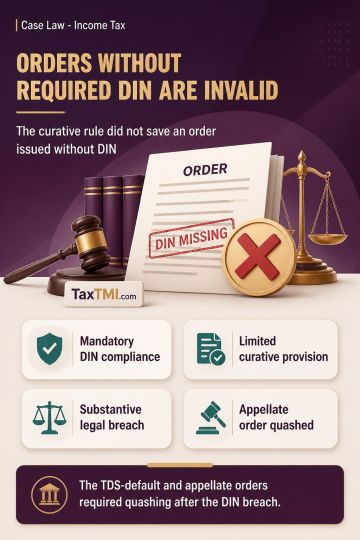
Document Identification Number compliance renders TDS-default orders invalid where mandatory DIN requirements are breached and curative provision does...
The SC upheld the High Court's determination that the appellant, a UAE tax resident company, maintained a fixed place PE in India under Article 5(1) of the India-UAE DTAA. Despite no single employee exceeding the nine-month presence threshold under Article 5(2), the aggregate continuous and coordinated business activities, including operational control and enforcement of compliance, established a substantive commercial nexus with the Indian hotel's core functions. The appellant's income from service charges under the SOSA agreements was thus attributable to the PE and taxable in India. The Court emphasized that taxability depends on business presence rather than global profitability, affirming that profit attribution to a PE is permissible even if the foreign enterprise incurs losses. The decision reinforces that the existence of a PE requires a fact-specific inquiry into control, supervision, and continuity of operations rather than a rigid formula.
The SC upheld the High Court's determination that the appellant, a UAE tax resident company, maintained a fixed place PE in India under Article 5(1) of the India-UAE DTAA. Despite no single employee exceeding the nine-month presence threshold under Article 5(2), the aggregate continuous and coordinated business activities, including operational control and enforcement of compliance, established a substantive commercial nexus with the Indian hotel's core functions. The appellant's income from service charges under the SOSA agreements was thus attributable to the PE and taxable in India. The Court emphasized that taxability depends on business presence rather than global profitability, affirming that profit attribution to a PE is permissible even if the foreign enterprise incurs losses. The decision reinforces that the existence of a PE requires a fact-specific inquiry into control, supervision, and continuity of operations rather than a rigid formula.
Note: It is a system-generated summary and is for quick reference only.
 TaxTMI
  TaxTMI
 of 4918