Inherited property sale proceeds require capital-gains treatment where ownership is supported by evidence, not suspicion or unverified signature doubt...
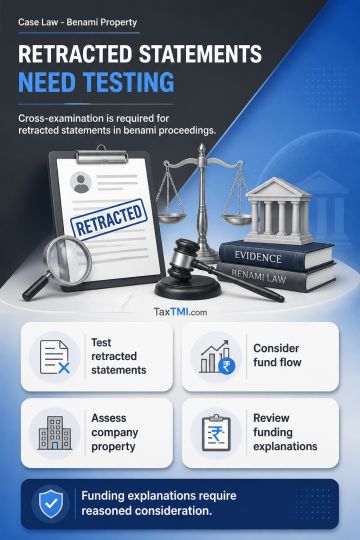
Cross-examination of retracted statements is essential where foundational evidence supports a benami allegation and documented funding explanations re...
Capital-goods exemption covers plant-modernisation accessories, while the import restriction applies only to earlier capital-goods components and spar...
Constitutional judicial review permits challenges to ECIRs and connected money-laundering proceedings where coercive action affects fundamental intere...
The ITAT held that penalty under section 270A cannot be imposed solely because the return was filed in response to a notice under section 148. Mere delay in filing does not amount to under-reporting unless there is concealment or misrepresentation of income. The assessee's income was fully disclosed, supported by third-party documents, subjected to TDS, and accepted without adjustment by the AO. The authority must exercise discretion judiciously before levying penalty, considering the assessee's bona fide conduct and absence of tax evasion. Since there was no addition or disallowance, and no revenue loss or fraudulent intent was established, the penalty was not warranted. The failure to file return under section 139(1) alone does not constitute under-reporting under section 270A(2)(b). Consequently, the appeal was allowed and the penalty under section 270A was set aside.
The ITAT held that penalty under section 270A cannot be imposed solely because the return was filed in response to a notice under section 148. Mere delay in filing does not amount to under-reporting unless there is concealment or misrepresentation of income. The assessee's income was fully disclosed, supported by third-party documents, subjected to TDS, and accepted without adjustment by the AO. The authority must exercise discretion judiciously before levying penalty, considering the assessee's bona fide conduct and absence of tax evasion. Since there was no addition or disallowance, and no revenue loss or fraudulent intent was established, the penalty was not warranted. The failure to file return under section 139(1) alone does not constitute under-reporting under section 270A(2)(b). Consequently, the appeal was allowed and the penalty under section 270A was set aside.
Note: It is a system-generated summary and is for quick reference only.
 TaxTMI
 of 4788



















 Join Channel


 TaxTMI