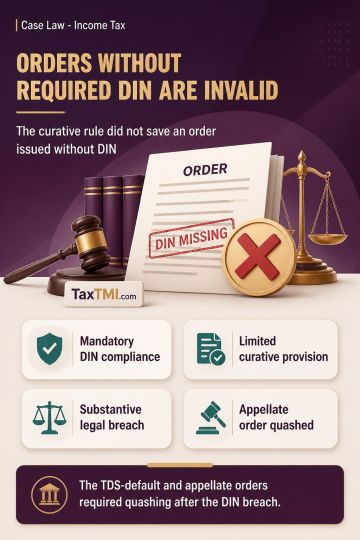
Document Identification Number compliance renders TDS-default orders invalid where mandatory DIN requirements are breached and curative provision does...
The ITAT held the penalty proceedings under section 271AAB(1A) invalid due to the Assessing Officer's failure to specify the exact clause under section 271AAB(1) for levy of penalty, rendering the penalty notice defective. Consistent with precedent, non-identification of the relevant limb vitiates the entire penalty process. The Tribunal further observed that the AO could not adopt a divergent stance across assessment years on identical facts, noting that no penalty was levied for AY 2020-21 on similar grounds. Additionally, the GST paid on undisclosed sales was rightly allowed as a deduction from gross profit in penalty computation. Since the assessee filed returns accepted without addition and the GST paid in relevant years effectively nullified undisclosed income, no penalty was sustainable. Consequently, the CIT(A) erred in granting only partial relief, and the ITAT quashed the entire penalty, dismissing Revenue's appeal and allowing the assessee's grounds.
The ITAT held the penalty proceedings under section 271AAB(1A) invalid due to the Assessing Officer's failure to specify the exact clause under section 271AAB(1) for levy of penalty, rendering the penalty notice defective. Consistent with precedent, non-identification of the relevant limb vitiates the entire penalty process. The Tribunal further observed that the AO could not adopt a divergent stance across assessment years on identical facts, noting that no penalty was levied for AY 2020-21 on similar grounds. Additionally, the GST paid on undisclosed sales was rightly allowed as a deduction from gross profit in penalty computation. Since the assessee filed returns accepted without addition and the GST paid in relevant years effectively nullified undisclosed income, no penalty was sustainable. Consequently, the CIT(A) erred in granting only partial relief, and the ITAT quashed the entire penalty, dismissing Revenue's appeal and allowing the assessee's grounds.
Note: It is a system-generated summary and is for quick reference only.
 TaxTMI
  TaxTMI
 of 4918