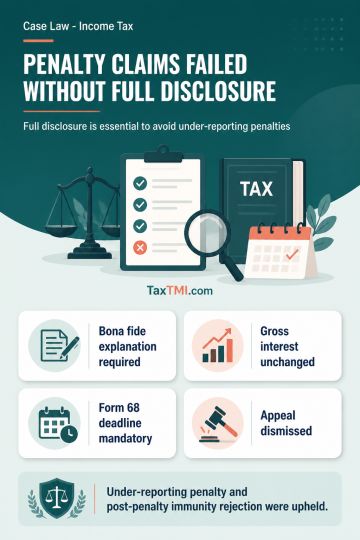
Bona fide disclosure requirements govern under-reporting penalties, and post-penalty immunity applications cannot secure available statutory protectio...
Certificate-of-origin verification procedure governs preferential customs benefits; denial without retroactive verification was set aside with consequ...
Disciplinary Committee jurisdiction and mandatory investigation requirements invalidated cancellation of an insolvency professional's registration and...
The HC held that since the entire tax liability was discharged through the electronic credit ledger before any intimation or show-cause notice, and there was no wilful mis-statement or suppression by the petitioner, the provisions of Sec. 74 of the GST Act are inapplicable. The petitioner's failure to offset the tax liability from the credit ledger was inadvertent and not indicative of fraud. Consequently, the HC directed the respondent AO to pass a fresh de novo order under Sec. 73 of the GST Act, after affording the petitioner an opportunity of hearing, within three months from receipt of the order. The petition was disposed of accordingly.
The HC held that since the entire tax liability was discharged through the electronic credit ledger before any intimation or show-cause notice, and there was no wilful mis-statement or suppression by the petitioner, the provisions of Sec. 74 of the GST Act are inapplicable. The petitioner's failure to offset the tax liability from the credit ledger was inadvertent and not indicative of fraud. Consequently, the HC directed the respondent AO to pass a fresh de novo order under Sec. 73 of the GST Act, after affording the petitioner an opportunity of hearing, within three months from receipt of the order. The petition was disposed of accordingly.
Note: It is a system-generated summary and is for quick reference only.
 TaxTMI
 of 4805














 Join Channel


 TaxTMI
