Authentication of paper assessment orders upheld, while qualifying repairs, consumables and vendor advance write-offs remain deductible business claim...
Transaction value cannot be rejected solely on non-statutory valuation guidelines without corroborative evidence supporting reassessment of final cust...
Cross-examination rights and corroborated evidence limit customs penalties for misdeclaration in genuine import transactions involving documented clea...
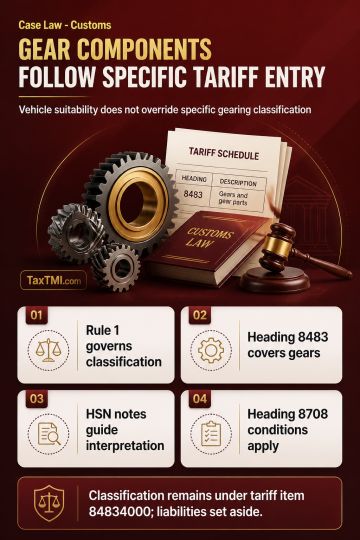
Tariff classification of vehicle gear components follows the specific gearing entry, displacing motor-vehicle parts classification and related liabili...
The HC held that since the entire tax liability was discharged through the electronic credit ledger before any intimation or show-cause notice, and there was no wilful mis-statement or suppression by the petitioner, the provisions of Sec. 74 of the GST Act are inapplicable. The petitioner's failure to offset the tax liability from the credit ledger was inadvertent and not indicative of fraud. Consequently, the HC directed the respondent AO to pass a fresh de novo order under Sec. 73 of the GST Act, after affording the petitioner an opportunity of hearing, within three months from receipt of the order. The petition was disposed of accordingly.
The HC held that since the entire tax liability was discharged through the electronic credit ledger before any intimation or show-cause notice, and there was no wilful mis-statement or suppression by the petitioner, the provisions of Sec. 74 of the GST Act are inapplicable. The petitioner's failure to offset the tax liability from the credit ledger was inadvertent and not indicative of fraud. Consequently, the HC directed the respondent AO to pass a fresh de novo order under Sec. 73 of the GST Act, after affording the petitioner an opportunity of hearing, within three months from receipt of the order. The petition was disposed of accordingly.
Note: It is a system-generated summary and is for quick reference only.
 TaxTMI
 of 4805




















 Join Channel


 TaxTMI