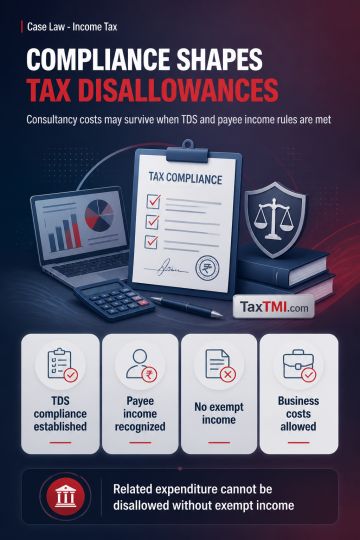
Tax deduction compliance and payee income recognition govern consultancy disallowance, while no exempt income prevents related expenditure disallowanc...
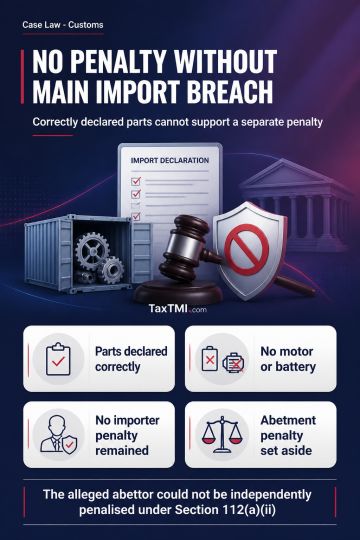
Derivative abetment liability fails when correctly declared imported components establish no underlying improper importation by the principal importer...
Tax exemption for regulatory authority income applies retrospectively, subject to non-commercial activity, unchanged income sources, and return filing...
Page of 4805
Press 'Enter' after typing page number.
701 to 720 of 96092 Results
❮
❯
❯❯
0 / 200
Expand Note
Add to Folder
No Folders have been created
+
Are you sure you want to delete "My most important" ?
The HC held that since the entire tax liability was discharged through the electronic credit ledger before any intimation or show-cause notice, and there was no wilful mis-statement or suppression by the petitioner, the provisions of Sec. 74 of the GST Act are inapplicable. The petitioner's failure to offset the tax liability from the credit ledger was inadvertent and not indicative of fraud. Consequently, the HC directed the respondent AO to pass a fresh de novo order under Sec. 73 of the GST Act, after affording the petitioner an opportunity of hearing, within three months from receipt of the order. The petition was disposed of accordingly.
The HC held that since the entire tax liability was discharged through the electronic credit ledger before any intimation or show-cause notice, and there was no wilful mis-statement or suppression by the petitioner, the provisions of Sec. 74 of the GST Act are inapplicable. The petitioner's failure to offset the tax liability from the credit ledger was inadvertent and not indicative of fraud. Consequently, the HC directed the respondent AO to pass a fresh de novo order under Sec. 73 of the GST Act, after affording the petitioner an opportunity of hearing, within three months from receipt of the order. The petition was disposed of accordingly.
Note: It is a system-generated summary and is for quick reference only.
 TaxTMI
 of 4805
















 Join Channel


 TaxTMI
