Extended limitation fails without specific suppression allegations, while overseas employee secondment remains taxable as manpower supply within norma...
Time-share accommodation classification excludes Club or Association Service where purchasers receive contractual occupancy rights without genuine mem...
CENVAT credit for trading requires reversal, while taxable-service rental credit remains proportionately available and limitation issues await resolut...
Vicarious liability for dishonoured company cheques may extend to non-signatory directors where complaints contain foundational responsibility avermen...
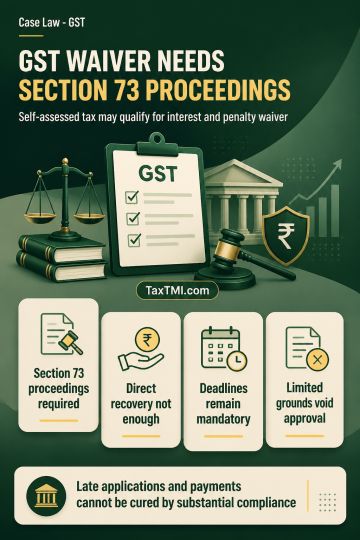
The HC held that since the entire tax liability was discharged through the electronic credit ledger before any intimation or show-cause notice, and there was no wilful mis-statement or suppression by the petitioner, the provisions of Sec. 74 of the GST Act are inapplicable. The petitioner's failure to offset the tax liability from the credit ledger was inadvertent and not indicative of fraud. Consequently, the HC directed the respondent AO to pass a fresh de novo order under Sec. 73 of the GST Act, after affording the petitioner an opportunity of hearing, within three months from receipt of the order. The petition was disposed of accordingly.
The HC held that since the entire tax liability was discharged through the electronic credit ledger before any intimation or show-cause notice, and there was no wilful mis-statement or suppression by the petitioner, the provisions of Sec. 74 of the GST Act are inapplicable. The petitioner's failure to offset the tax liability from the credit ledger was inadvertent and not indicative of fraud. Consequently, the HC directed the respondent AO to pass a fresh de novo order under Sec. 73 of the GST Act, after affording the petitioner an opportunity of hearing, within three months from receipt of the order. The petition was disposed of accordingly.
Note: It is a system-generated summary and is for quick reference only.
 TaxTMI
 of 4800













 Join Channel


 TaxTMI
