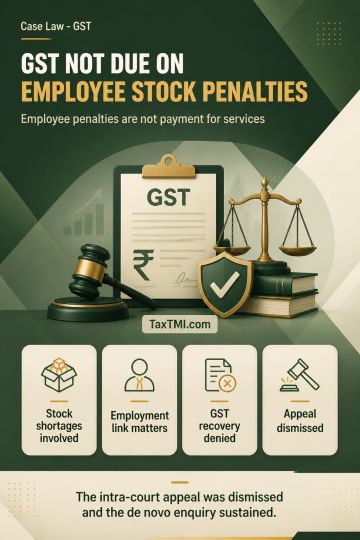
Employee stock-shortage penalties do not constitute consideration for services, preventing GST collection under Schedule II in employment relationship...
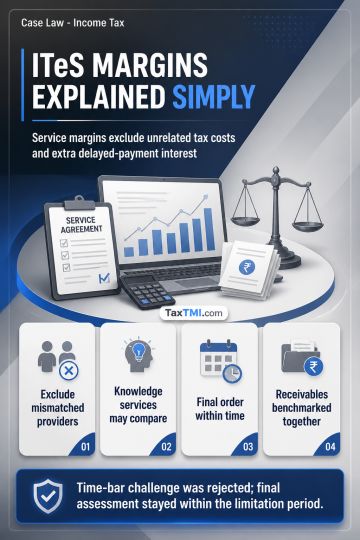
Transfer-pricing treatment of ITeS margins excludes pass-through tax recoveries and separate delayed-receivables interest after working-capital adjust...
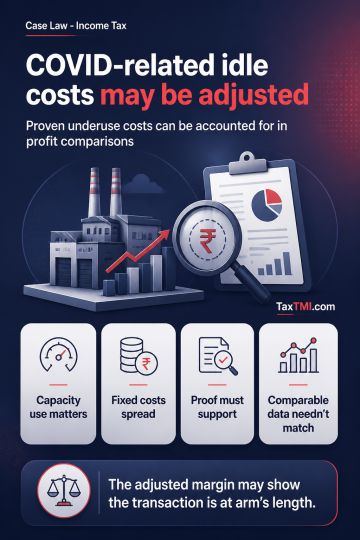
Capacity-utilisation adjustments under TNMM can neutralise substantiated COVID-related idle costs where underutilisation materially affects profitabil...
Page of 4830
Press 'Enter' after typing page number.
181 to 200 of 96587 Results
❮
❯
❯❯
0 / 200
Expand Note
Add to Folder
No Folders have been created
+
Are you sure you want to delete "My most important" ?
The CESTAT affirmed the dismissal of a refund claim under service tax provisions, holding it barred by the limitation period prescribed in Section 11B of the Central Excise Act, 1944, as applied via Section 83 of the Finance Act, 1994. The Tribunal relied on binding precedent from a nine-judge bench of the Supreme Court, which confirmed that claims for refund arising from misapplication of excise or customs laws must comply with the statutory limitation and procedural requirements within the self-contained enactments. The appellant's argument challenging the applicability of the limitation period was rejected as untenable. Consequently, the Tribunal upheld the Appellate Authority's order dismissing the refund claim on the ground of limitation, and the appeal was accordingly dismissed with no interference warranted.
The CESTAT affirmed the dismissal of a refund claim under service tax provisions, holding it barred by the limitation period prescribed in Section 11B of the Central Excise Act, 1944, as applied via Section 83 of the Finance Act, 1994. The Tribunal relied on binding precedent from a nine-judge bench of the Supreme Court, which confirmed that claims for refund arising from misapplication of excise or customs laws must comply with the statutory limitation and procedural requirements within the self-contained enactments. The appellant's argument challenging the applicability of the limitation period was rejected as untenable. Consequently, the Tribunal upheld the Appellate Authority's order dismissing the refund claim on the ground of limitation, and the appeal was accordingly dismissed with no interference warranted.
Note: It is a system-generated summary and is for quick reference only.
 TaxTMI
  TaxTMI
 of 4830



 Join Channel


